
Introduction:
Every decade introduces a new set of technologies that promise to change the world. Governments formulate policies around them, investors pour billions into startups, and the media forecasts a future transformed by innovation. Yet, surprisingly often, these celebrated technologies fail to mature into the revolutionary forces they were expected to become.
The history of technology is not merely a story of inventions succeeding. It is equally a story of innovations that arrived too early, encountered unforeseen barriers, or simply failed to fit comfortably into human society.
Asymmetry of Complexity:
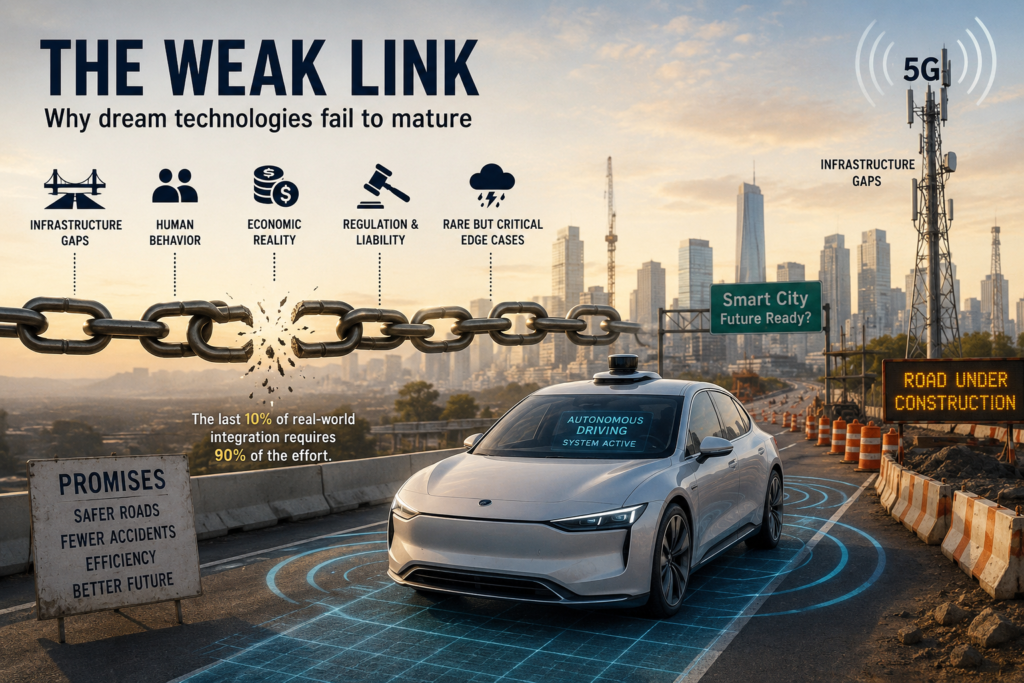
While cutting-edge technologies are often launched on the promise of linear progress, their failure to achieve mainstream maturity within a decade stem from an ‘asymmetry of complexity’—where solving the final 10% of real-world integration requires exponentially more infrastructure, ethical consensus, and technical problem-solving than the initial 90%.
The history of technology suggests a paradox. The first 90 percent of innovation is often achieved through scientific breakthroughs and engineering ingenuity. The final 10 percent—making a technology reliable, affordable, trusted, regulated, and socially accepted—may require more effort than all previous stages combined.
Driverless Cars, 5G, and the Hidden Obstacles to Technological Maturity:
Consider autonomous vehicles. Around 2020, the convergence of artificial intelligence, sensors, cloud computing, and 5G communications created enormous excitement. Experts predicted that driverless cars would soon dominate roads, reduce accidents, eliminate traffic congestion, and fundamentally reshape transportation. Some forecasts suggested that private car ownership itself might become obsolete; by 2025, steering wheels will be obsolete.
Six years later, autonomous vehicles remain largely confined to controlled environments and limited pilot deployments. While remarkable technical progress has been achieved, fully driverless transportation has not become a normal part of everyday life for most people.
Autonomous vehicles are not unique. Virtual reality, blockchain applications, smart cities, the metaverse, commercial drones, and even some 5G use cases have followed similar trajectories. They were introduced as transformative technologies, yet years later many remain confined to niche deployments.
A cutting-edge technology rarely exists in a vacuum; it requires a symbiotic ecosystem to function. In 2020, 5G was marketed as the nervous system that would allow driverless cars to talk to each other instantly (vehicle-to-everything, or V2X communication). However, rolling out true millimeter-wave 5G infrastructure globally is incredibly expensive and slow. Without the network, the cars couldn’t reach full autonomy; without the cars, network providers lacked incentive to build the expensive infrastructure.
Why does this happen?
Inventing a technology and integrating it into society are entirely different challenges. Many innovations appear feasible in laboratory demonstrations but encounter extraordinary complexity in the real world.
A driverless car can successfully navigate a predictable test route. However, city streets contain endless variations—unpredictable pedestrians, unusual weather conditions, poorly marked roads, construction zones, human drivers making irrational decisions, and countless rare situations that software struggles to interpret.
Emerging technologies pass through a familiar cycle. Initial breakthroughs generate excitement. Expectations rise rapidly. Investors and commentators predict revolutionary transformation. Reality then intervenes, revealing practical limitations and slower-than-expected adoption. Disappointment follows.
Innovation has to be seen as not simply a technical trajectory but a socio‑technical process shaped by economics, regulation, human factors, infrastructure, and market incentives.
The gaps in supporting infrastructure:
The final ten percent of a problem often requires ninety percent of the effort.
Supporting Infrastructure Evolves Slowly. A technology rarely succeeds on its own.
Electric vehicles require charging networks. Digital payments require financial infrastructure. Streaming services require high-speed broadband. Autonomous vehicles require highly reliable communications, mapping systems, regulatory frameworks, and sophisticated road infrastructure.
Even when the technology itself works, the surrounding ecosystem may lag behind. Cutting‑edge products often rely on advances across hardware, software, sensors, networks, and mapping. Weakness in any layer (sensor limits, ML generalization, low‑latency network gaps) can block overall performance.
Complementary infrastructure often lags. Driverless vehicles depend on reliable maps, road markings, V2X communications, and dense broadband—none of which are uniformly available. Public infrastructure and urban design were not built for the new technology, creating misfits that require long political timelines to change.
Many issues are low frequency but high consequence (adverse weather, unusual human behaviour, infrastructure failures). Addressing these requires disproportionate effort, testing, and data.
The rollout of 5G illustrates this challenge. While the technology delivers impressive capabilities, many applications originally associated with it—remote surgery, autonomous transportation, massive industrial automation—depend on complementary investments that take years or decades to materialize.
Human Behaviour Is Not an Engineering Problem:
Human Behaviour Changes More Slowly Than Technology. Technologists often assume that people will eagerly adopt superior solutions. History suggests otherwise. Humans do not make decisions based solely on efficiency. They value familiarity, trust, habit, culture, and personal control.
Many people enjoy driving. Others may feel uncomfortable surrendering control to an algorithm. Even if autonomous vehicles become statistically safer than human drivers, public acceptance may take much longer than engineers expect.
Job and social impacts (e.g., on drivers, logistics workers) provoke political resistance and can stall favourable policy.
Economic Failure:
Technologies do not compete against perfection; they compete against existing solutions that are already cheap, familiar, and widely available. Economic Reality Defeats Technological Possibility. Many technologies fail not because they are impossible but because they are uneconomic.
A solution may work brilliantly while remaining too expensive for widespread deployment. Early autonomous vehicle systems require costly sensors, extensive computing power, and continuous software maintenance. The economic case may not yet justify replacing existing transportation systems.
History contains numerous examples of technically successful but commercially unsuccessful innovations. Supersonic passenger travel, represented by the Concorde, demonstrated extraordinary engineering achievement but could not achieve sustainable economics.
Markets eventually determine which innovations survive.
Regulatory Visibility:
Regulation and Liability Create Invisible Barriers. Society expects technology to operate within legal and ethical boundaries.
If a driverless car causes an accident, who bears responsibility? The vehicle owner? The software developer? The manufacturer? The telecommunications provider? Such questions are difficult to answer and often delay deployment.
Regulatory systems move cautiously because they must balance innovation with public safety. As a result, legal frameworks frequently lag behind technological capability.
Expectations Are Usually Inflated. Perhaps the most important explanation is that society systematically overestimates short-term technological change while underestimating long-term change.
Telecom Policy Insight:
Telecom history offers many examples of this phenomenon. 3G, WiMAX, IPTV, smart homes, and even early 5G applications were launched with expectations that far exceeded initial adoption. The lesson is that communications technologies often evolve in layers: infrastructure arrives first, viable applications emerge later, and widespread societal transformation occurs much later still.
Psychological Concepts:
The groundbreaking technologies often plateau for a decade or more after their introduction. This structural delay is best explained by the following concepts:
Amara’s Law: This principle states that we tend to overestimate the effect of a technology in the short run and underestimate its effect in the long run. The initial excitement creates a rush to market with premature products, resulting in a profound societal bottleneck when the technology fails to instantly reshape daily life.
The Gartner Hype Cycle: This psychological phenomenon directly feeds into a predictable lifecycle. Technologies launch into a “Peak of Inflated Expectations,” fuelled by intense media and investor buzz. However, when early deployments hit real-world complexities, they plunge into the “Trough of Disillusionment.” It is in this trough where technologies like 5G and autonomous vehicles have spent the last decade, slowly grinding through engineering realities to climb toward actual productivity.
Conclusion:
A technology reaches maturity when people stop talking about it and simply use it. Electricity, mobile phones, GPS navigation, and broadband internet succeeded because they eventually became invisible parts of everyday life.
Only later, often quietly and without media attention, does the technology mature and find its genuine role.
The internet itself followed this pattern. The dot-com crash of 2000 convinced many observers that internet businesses had been overhyped. Yet two decades later, digital platforms dominate global commerce and communication.
Many technologies introduced as cutting edge remain trapped in an intermediate stage—technically impressive but socially immature. Autonomous vehicles, virtual reality, the metaverse, blockchain applications, and certain 5G use cases may still be traveling this path.
The decade-long stagnation of driverless cars and 5G networks is not a story of catastrophic failure, but a necessary calibration period. The “Long Tail” problem continues to impose a brutal technical safety ceiling, proving that coding for chaotic real-world edge cases requires an entirely different level of cognitive flexibility than standard navigation.
This decade-long lag serves as a vital safety buffer, allowing society to rewrite its legal systems, deploy infrastructure, and adapt its psychology. True technological maturity does not occur when an innovation sounds like science fiction; it happens when the technology becomes so deeply integrated, reliable, and invisible that we stop talking about it altogether.
The lesson is clear: innovation is not merely about creating technology. It is about aligning technology with economics, infrastructure, regulation, and human behaviour. Until that alignment occurs, even the most celebrated inventions may remain perpetually “promising.”
Technology grows not when engineers declare it ready, but when society quietly adopts it as indispensable.
History teaches us that technological revolutions are rarely sudden. They unfold through long periods of experimentation, disappointment, adaptation, and gradual acceptance. The true measure of innovation is not whether it dazzles investors or dominates headlines, but whether it quietly becomes indispensable. A technology reaches maturity not when it is announced, but when society forgets that it is new.