
Every city tells a story through its streets.
For millions of Indians, that story is not written from behind the steering wheel of a car. It is written in footsteps—walking to the bus stop, the railway station, the local market, the office, or accompanying children to school.
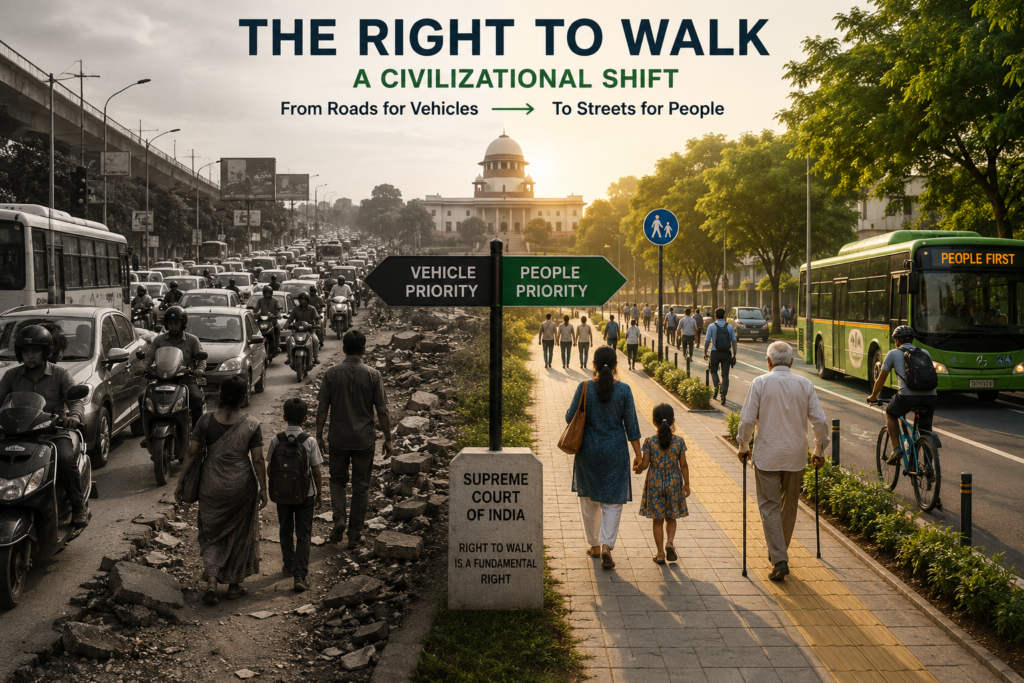
Yet, walking in most Indian cities has become an everyday act of courage.
Pedestrians routinely dodge speeding vehicles, climb over broken pavements, step into moving traffic because cars occupy footpaths, and compete with motorcycles that treat sidewalks as shortcuts. In many places, the pedestrian has become the least important user of public roads.
That is why the recent Supreme Court judgment in Maniyar Iliyaz v. P. Ayyappan marks a watershed moment in India’s urban development.
The Court unequivocally declared that the Right to Walk is a fundamental right protected under Articles 19 and 21 of the Constitution. More importantly, it held that pedestrian safety must receive priority over motorised traffic.
For the common citizen, this is far more than a legal pronouncement. It is a recognition that cities exist for people first, and vehicles second.
A Constitutional Shift in Urban Planning
The judgment fundamentally changes how roads must be viewed.
Until now, Indian roads have largely been designed to maximise the movement of vehicles. Footpaths, when provided at all, were often treated as optional infrastructure.
The Supreme Court has now established a different principle:
If a road exists, a safe and usable pedestrian pathway must exist alongside it.
This seemingly simple statement has profound implications. It transforms pedestrian infrastructure from a desirable civic amenity into a constitutional obligation.
The responsibility now lies squarely with urban development authorities, municipal corporations, municipalities, and panchayats to ensure that roads are not merely drivable but also walkable.
A Victory for Citizens—and a Daunting Challenge for Local Governments
While citizens have welcomed the judgment, local bodies face one of the biggest urban infrastructure challenges in decades.
Providing continuous, safe pedestrian corridors throughout existing cities will require simultaneous reforms in policy, engineering, administration, and finance.
1. Rethinking the “Right of Way”
Indian road planning has historically prioritised motor vehicles.
This judgment demands a reversal of that philosophy by placing pedestrians at the centre of road design.
The implications extend well beyond construction.
Local bodies must now:
- redesign roads to include uninterrupted pedestrian pathways;
- prevent parking on footpaths;
- regulate street vending without blocking pedestrian movement;
- stop two-wheelers from using sidewalks as traffic lanes; and
- ensure that newly created pedestrian spaces remain accessible throughout their life cycle.
This requires coordinated action between municipal authorities, traffic police, urban planners, and enforcement agencies.
2. The Engineering Challenge
Building footpaths on new roads is relatively straightforward.
Retrofitting them into existing cities is an entirely different challenge.
Beneath almost every urban road lies a maze of water pipelines, sewer lines, electricity cables, fibre-optic networks, drainage systems, and communication ducts. Many of these utilities were installed over decades with incomplete documentation.
Creating continuous pedestrian corridors often means relocating this underground infrastructure without disrupting essential services.
Older cities also present numerous physical constraints:
- irregular road widths,
- narrow bottlenecks,
- varying ground levels,
- inadequate drainage, and
- densely built commercial frontages.
Designing universally accessible walkways through such environments demands innovative engineering rather than standard templates.
3. The Administrative and Financial Reality
Perhaps the greatest challenge lies in administration.
In many urban areas, roads simply do not have enough space to accommodate modern pedestrian infrastructure without affecting adjoining properties.
This raises difficult questions involving:
- land acquisition,
- removal of encroachments,
- compensation,
- rehabilitation,
- political consensus, and
- public acceptance.
The financial implications are equally significant.
Constructing thousands of kilometres of durable, accessible, well-lit footpaths represents a major capital investment.
For many Urban Local Bodies (ULBs), already operating under severe financial constraints, implementation will require sustained support from State Governments, improved urban financing, and innovative funding mechanisms such as Public-Private Partnerships where appropriate.
A New Dimension of Municipal Accountability
Perhaps the most significant aspect of the judgment is not the engineering—it is accountability.
The Supreme Court observed that citizens whose right to safe pedestrian movement is violated may seek constitutional remedies, including compensation, where public authorities fail in their duties.
This changes the legal landscape.
Municipal bodies can no longer treat pedestrian infrastructure as a low-priority civic project. Failure to provide safe walking conditions may now carry constitutional consequences.
The emphasis shifts from reacting after accidents occur to preventing them through better planning and maintenance.
Beyond Roads: A Public Health Revolution
The judgment also has important implications for public health.
Cities that encourage walking experience lower pollution, healthier populations, reduced congestion, and greater social interaction.
Safe footpaths benefit everyone—but especially:
- senior citizens,
- children,
- persons with disabilities,
- women,
- public transport users, and
- lower-income households who depend on walking every day.
Ironically, those who walk the most have historically received the least attention in urban planning.
The Court’s decision helps correct that imbalance.
Building Cities for People
Transforming Indian roads into pedestrian-friendly spaces will not happen overnight.
It will require political will, careful engineering, sustained funding, and years of coordinated execution.
Mistakes will be made. Projects will face delays. Budgetary constraints will be real.
Yet the direction is now unmistakable.
The Supreme Court has reminded us that roads are public spaces, not merely traffic corridors.
A truly modern city is not measured by the number of flyovers it builds or the speed at which cars travel. It is measured by something far simpler:
Can a child walk safely to school? Can an elderly citizen cross the road with dignity? Can every person move through the city without fear?
If this judgment succeeds in changing how India answers those questions, it may well become one of the most transformative urban planning decisions in the country’s constitutional history.
Walking has always been our oldest form of mobility.
Perhaps it is finally receiving the place it deserves.