
Research Paper, September 2026
Based on C-DOT Annual Reports FY2023–24 and FY2024–25,
and International Benchmarking.

Executive Summary
This report examines whether India’s telecom innovation ambitions, including indigenous 6G capability, can realistically be achieved through C-DOT under its present institutional architecture. The study began with original hypothesis that a significant institutional gap exists between C-DOT and leading global telecom technology companies and that closing the gap may require greater commercial autonomy and access to capital.
The evidence developed through the C-DOT Annual Reports and the international benchmarking stages produces a more precise conclusion. C-DOT is not technologically stagnant or financially incapable. Its income has risen strongly, technology-linked income is significant, identifiable research/technology expenditure increased materially, and the organisation has demonstrated the ability to develop and transfer indigenous telecom technology. The central problem is the scale and architecture through which capability is converted into IP, standards influence, products, deployment, commercial returns and reinvestment.
In 2025, Huawei reported CNY 880.9 billion revenue and CNY 192.3 billion R&D; Nokia EUR 19.889 billion sales and EUR 4.855 billion R&D; Ericsson SEK 236.7 billion sales and SEK 48.9 billion R&D; and Samsung Electronics KRW 333.6 trillion revenue and KRW 37.8 trillion R&D. C-DOT’s FY2025 total income was ₹566.72 crore and identifiable research/technology expenditure approximately ₹113.97 crore. These measures are not accounting-equivalent, but the absolute scale difference is unmistakable.
The report therefore does not propose making C-DOT another Huawei, Nokia, Ericsson or Samsung. The realistic objective is strategic equivalence in selected 6G domains. C-DOT should become the national technology nucleus while Indian industry, startups, academia, operators, semiconductor companies and manufacturing partners provide the scale required for products and markets.
The proposed reform is a hybrid model: a protected national research core with operational freedom, governed by an independent professional board, supported by multi-year strategic public funding and linked to a commercially agile technology-commercialisation and investment function. Government remains the strategic owner and steward. It defines the mission, security boundaries and broad resource envelope; it does not manage individual research decisions.
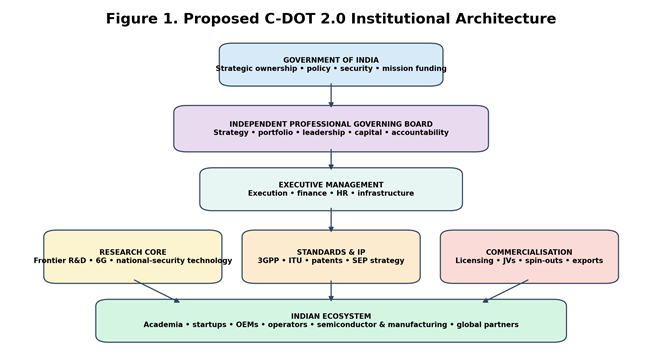
Figure 1. Proposed C-DOT 2.0 Institutional Architecture.
A critical safeguard is an institutional firewall between strategic Government oversight and operational technology decisions. Government receives continuous technology intelligence through a structured dashboard and annual strategic technology dialogue. Routine scientific, personnel, procurement and commercial decisions are delegated. This is designed to prevent a superficially autonomous structure whose underlying decision culture remains bureaucratic.
Chapter 1 — The Research Question, Scope and Method
The study began with a deliberately demanding hypothesis:
H1: There exists a significant institutional gap between C-DOT and leading global telecom technology companies. Closing this gap under the current funding and governance model may be difficult. Institutional reforms that increase commercial autonomy and access to capital are therefore likely to be required if the Government’s Vision 2047 is to be achieved.
The deeper question is broader: “Can India’s telecom innovation ambitions be realised under the present institutional architecture, or does the architecture itself need to evolve?”
1.1 Scope
- Establish a defensible C-DOT baseline from FY2023–24 and FY2024–25 Annual Reports.
- Compare C-DOT with Huawei, Nokia, Ericsson and Samsung using the 2025 evidence compiled in the international phase.
- Assess finance, R&D, human capital, IP, patents, standards, technology, commercialisation, global reach, autonomy and capital access.
- Distinguish scale gaps from institutional gaps and develop an implementable reform model.
1.2 Evidence Discipline
The research preserves differences in accounting and institutional definitions. C-DOT total income is not treated as identical to corporate revenue. Its identifiable research/technology expenditure is not presented as a directly comparable corporate R&D measure. N/D is used where information is not disclosed, and original currencies and definitions are retained.
1.3 Why Architecture Matters
In frontier technology, the speed at which an institution can recruit a specialist, approve an experiment, shift resources, negotiate a partnership, protect international IP or create a commercial vehicle can determine whether an opportunity is captured or lost. Institutional architecture is therefore a technology variable, not merely an administrative variable.
Chapter 2 — C-DOT’s Financial and Organisational Baseline
The C-DOT Annual Reports reveal a significant improvement in financial trajectory. This is important because the reform case should build on demonstrated institutional strengths rather than assume that public research organisations are inherently inefficient.
| Metric | FY2023 | FY2024 | FY2025 | Interpretation |
| Total income | ₹259.57 cr | ₹406.68 cr | ₹566.72 cr | +118.33% |
| Total expenditure | ₹544.39 cr | ₹775.32 cr | ₹820.82 cr | Growth slower than income |
| Excess expenditure | ₹284.82 cr | ₹368.64 cr | ₹254.09 cr | FY2025 improvement |
| Income coverage | 47.68% | 52.45% | 69.04% | Material improvement |
| Expenditure / income | 2.10× | 1.91× | 1.45× | Lower relative gap |
| Total assets | ₹1,113.51 cr | ₹1,364.18 cr | ₹1,635.65 cr | +46.89% |
| Net block | ₹94.91 cr | ₹139.40 cr | ₹171.57 cr | +80.78% |
Technology-linked income dominated the income structure: TOT, royalty, TSR/FSR and publication income represented approximately 87.13% of income in FY2024 and 88.74% in FY2025. This is evidence that C-DOT’s technology activities can create economic value.
2.1 Expenditure Structure
| Item | FY2024 share | FY2025 share | Change |
| Establishment | 51.13% | 58.47% | +21.07% |
| Operational | 35.45% | 22.31% | -33.39% |
| Other administration | 7.57% | 12.35% | +72.76% |
| Depreciation | 5.85% | 6.87% | +24.33% |
The shift towards establishment expenditure raises a strategic question: how much of the resource envelope can be flexibly directed towards frontier technology? The issue is not that personnel expenditure is undesirable. A technology institution needs people. The issue is whether the organisation can flexibly expand the specialist capabilities required by strategic technology programmes.
2.2 Critical R&D Measurement Correction
The FY2025 operational-expenditure total should not be treated as R&D. Schedule 10 identifies research- and technology-related components. The reconstructed identifiable research/technology-related expenditure is approximately ₹113.97 crore in FY2025, compared with ₹66.11 crore in FY2024, an increase of about 72.4%. It is not directly comparable with corporate R&D disclosures.
Chapter 3 — Technology Capability and the Indigenous 6G Opportunity
C-DOT is significant because it is already a technology-development institution. Indigenous 4G/5G core and RAN work, O-RAN and standards-oriented activity, security, quantum and AI-related programmes and technology transfer provide a foundation for a larger 6G capability.
3.1 What Indigenous 6G Should Mean
Indigenous 6G should not mean that every component is developed and manufactured inside one Government organisation. A more meaningful objective is strategic technological sovereignty: India should possess sufficient domestic capability to originate, control, integrate or influence strategically important technologies, standards and IP, with Indian companies capable of turning those assets into deployable products.
3.2 Strategic Window
6G remains under development and standardisation. The final architecture is not fixed, but global firms are already deeply engaged in the process. India’s opportunity therefore remains open, but the window will narrow as standards and markets mature.
3.3 Strategic Equivalence
India should target strategic equivalence in selected 6G domains rather than organisational imitation. C-DOT can concentrate on indigenous core and RAN, AI-native networks, security, quantum-safe communications, optical systems, sensing and other domains where differentiated capability is plausible.
3.4 The Wider 6G Ecosystem: C-DOT as Anchor, Not Monopoly
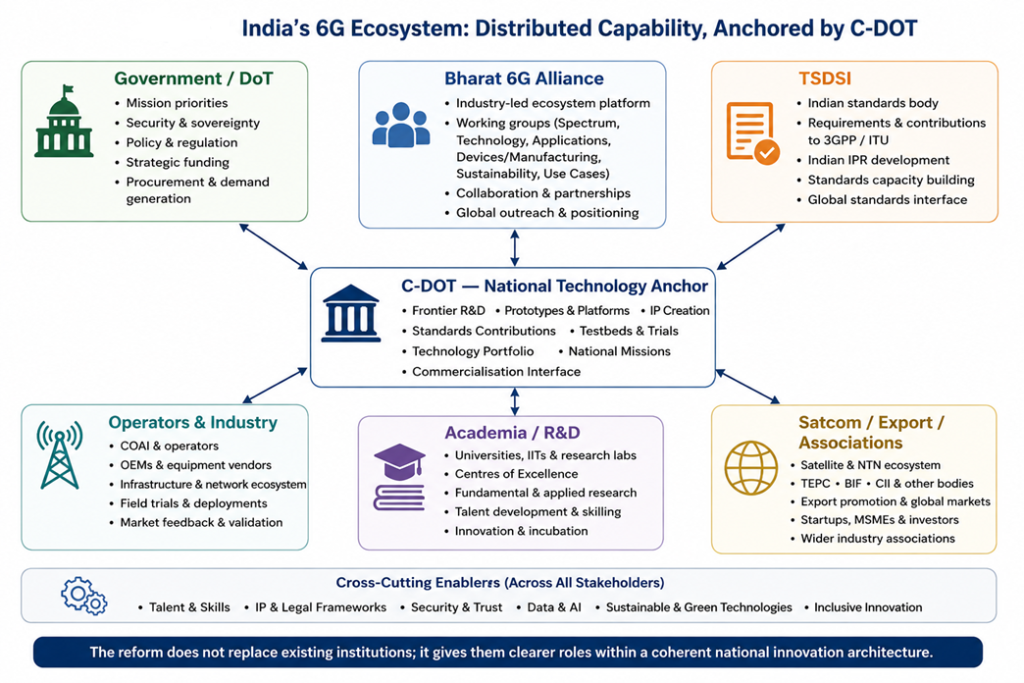
India’s 6G effort is already distributed across a substantial institutional ecosystem. The Bharat 6G Alliance (B6GA), launched in 2023 as an industry-led, government-facilitated platform, brings together industry, academia, research institutions and standards organisations. Its working groups cover areas including spectrum, devices/components/sensors/manufacturing, technology, applications, green and sustainability, and 6G use cases and revenue streams. The Alliance therefore provides an important ecosystem-coordination layer rather than a substitute for a national technology-development institution.
TSDSI performs a different but complementary function. It is India’s autonomous, membership-based telecom standards development organisation and explicitly seeks to carry Indian requirements and Indian innovations into global standards while encouraging creation of Indian IPR. Its current work programme includes 5G/6G topics such as AI-native networking, integrated terrestrial–non-terrestrial networks, RIS, security and IMT-2030/6G requirements. This makes standards participation a distinct institutional capability that must remain tightly connected to, but organisationally differentiated from, C-DOT’s research portfolio.
Industry associations and market-facing bodies add further capabilities that a public R&D institution should not attempt to duplicate. COAI provides an industry forum representing operators and a broader digital-communications ecosystem; Broadband India Forum (BIF) brings together technology providers, operators, ISPs, satellite interests, startups and other stakeholders; and the Telecom Equipment & Services Export Promotion Council (TEPC) focuses on telecom exports and international market facilitation. Satellite and space-sector organisations, equipment and device associations, semiconductor and electronics bodies, startups, venture investors and user-industry groups also matter as 6G moves toward integrated terrestrial–non-terrestrial networks and new application domains.
The implication for the reform proposed in this paper is important: the objective is not to centralise India’s 6G effort inside C-DOT. Rather, C-DOT should become the national technology anchor and portfolio integrator for strategically important telecom technologies, while existing ecosystem institutions retain their comparative roles. The reform should connect these institutions through clearly defined interfaces for research, standards, testbeds, IP, productisation, deployment, investment and exports. This preserves pluralism and avoids creating another bureaucratic layer.
Chapter 4 — International Benchmarking: Scale and Capability
The international comparison shows that the global leaders are integrated technology systems rather than merely large R&D laboratories.
| Institution | 2025 revenue/sales | 2025 R&D | Employees | Selected indicator |
| C-DOT | ₹566.72 cr total income | ₹113.97 cr identifiable* | ≈1,000 professionals** | Indigenous 4G/5G; growing 6G |
| Huawei | CNY 880.941 bn | CNY 192.3 bn | ≈213,000 | 170+ countries; >7,000 standards contributions; 165,000 active granted patents |
| Nokia | EUR 19.889 bn | EUR 4.855 bn | 78,005 average | 300 standardisation organisations; >100 leadership positions; 408 commercial 5G agreements |
| Ericsson | SEK 236.7 bn | SEK 48.9 bn | 86,536 latest disclosed | 180 countries; 206 live 5G networks; 60,000+ patents |
| Samsung Electronics | KRW 333.606 tn | KRW 37.8 tn | 259,149 | 40 R&D centres; 76-country operations; 3GPP TSG RAN chair |
* C-DOT figure is reconstructed identifiable research/technology expenditure and is not corporate R&D.
** Current public workforce description, not audited FY2025 headcount.
4.1 Lessons from the Global Firms
- Huawei: internally funded innovation, deep R&D staffing, extensive IP and standards participation. The lesson is institutional alignment and autonomy, not ownership replication.
- Nokia: professionalised standards and IP functions connected to technology strategy and product engineering.
- Ericsson: a continuous loop linking research, standards, products, deployment and customers.
- Samsung: diversified technology capabilities linking telecom with semiconductors, devices, AI and manufacturing.
The scale gap is therefore systemic. C-DOT cannot and need not reproduce the entire breadth of these corporations. India needs an ecosystem in which C-DOT supplies strategic technology and Indian industry supplies scale.
Chapter 5 — IP, Patents, SEPs and Standards Leadership
Technology leadership depends increasingly on the ability to influence standards and convert IP into economic and strategic value. Patents alone are insufficient; the relevant chain is research → patent → standards → adoption → licensing or product advantage.
C-DOT has an established patent/IP base and a role in the Indian and international standards ecosystem. The gap is the scale and global commercial integration of that IP system. Huawei reported 165,000 active granted patents in 2025; Nokia reported about 20,000 patent families and more than 3,500 5G-essential families in its disclosure; Ericsson reported more than 60,000 granted patents. These measures are not directly equivalent but demonstrate the depth of the global systems.
Standards leadership is equally important. C-DOT should establish a permanent Standards and IP Office tracking contributions, accepted work items, leadership positions, patent families, SEP candidates, international filings, licensing and adoption.
International patent filing should be selective and concentrated in 6G domains where C-DOT and its ecosystem have a credible prospect of influencing architecture.
Chapter 6 — Human Capital, Talent and Research Capacity
Human capital is the foundation of the transformation. Global firms operate with engineering and R&D populations measured in tens of thousands; C-DOT’s current public workforce description is about 1,000 professionals. This affects not only scale but the number of simultaneous uncertain technology bets the institution can make.
6.1 Preventing Bureaucratic Research Culture
- Flexible lateral recruitment for scarce skills.
- Competitive compensation mechanisms within transparent rules.
- Visiting scientist and global expert programmes.
- Researcher-led project formation within approved strategic portfolios.
- Recognition and incentives linked to patents, standards, milestones and commercialisation.
- Clear distinction between justified technical failure and negligence or misconduct.
The principle should be: Government and the Board decide what strategic outcomes India requires; researchers decide how to pursue them. Projects are evaluated through milestones and portfolio outcomes rather than pre-approval of every technical choice.
6.2 Portfolio Capacity
A genuine 6G institution must run multiple uncertain programmes simultaneously. If only a few experiments can be attempted because each consumes a disproportionate share of people and management attention, the probability of breakthrough falls. The objective is therefore portfolio capacity, not simply project excellence.
Chapter 7 — Commercialisation, Capital and the Route to Scale
The most consequential gap is conversion of research into large-scale commercial capability. C-DOT already generates technology-linked income. The challenge is to make technology-to-market a repeatable institutional function.
7.1 Why More Grant Funding Alone Is Insufficient
A larger annual grant increases resources but does not automatically create product engineering, manufacturing relationships, global sales or flexible scale-up capital. The missing mechanism is the ability to deploy capital and commercial decisions at market speed.
7.2 Commercialisation Vehicle
A professionally governed commercialisation subsidiary or affiliated technology vehicle should be able to license technologies, form JVs, create or invest in spin-outs, negotiate commercial agreements and raise appropriate external capital. The protected research core remains focused on long-horizon technology.
7.3 National Telecom Technology Investment Mechanism
A dedicated long-horizon capital mechanism can combine Government capital with strategic and institutional capital for scale-up. Its objective should be technology deployment and national capability rather than short-term financial return.
7.4 Industry as Route to Scale
C-DOT should not attempt to manufacture everything. Its comparative advantage is research, IP, reference architectures, software stacks, prototypes, validation and standards. Indian OEMs, startups, semiconductor firms, manufacturers and operators should provide industrialisation and deployment.
7.5 Customer-Led Productisation
Every major technology programme should identify the intended customer environment early. Readiness should be measured through interoperability, field trials, reliability, cost targets, deployment readiness and customer acceptance—not laboratory completion alone.
Chapter 8 — Institutional Reform: Government Stewardship and Operational Autonomy
The research does not support conventional privatisation. It supports institutional evolution: retain strategic Government control while separating strategic control from operational control.
8.1 Core Principle
Government should control the destination, but C-DOT should have the freedom to determine the route.
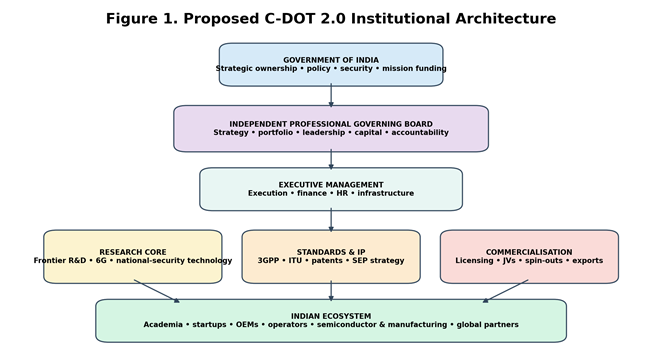
Figure 1. Proposed C-DOT 2.0 Institutional Architecture.
8.2 Decision Rights Charter
A formal Decision Rights Charter should specify decisions belonging to Government, the Board, management and research leadership. The Board governs the portfolio; researchers govern the science; commercial professionals operate within delegated limits.
8.3 Preventing Superficial Autonomy
Autonomy must be measurable through research approval time, specialist recruitment time, procurement cycle time, partnership approval time, technology-transfer time, licensing time and the proportion of decisions requiring external approval. If these do not improve, structural reform has not produced behavioural reform.
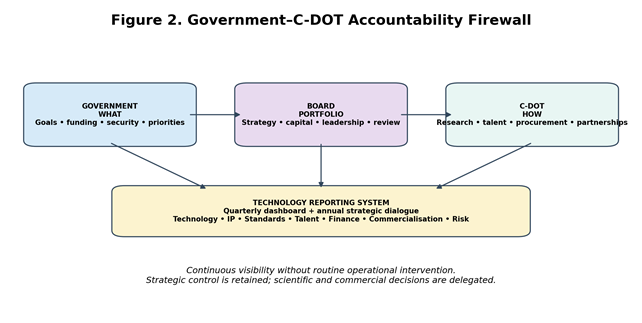
Figure 2. Government–C-DOT Accountability Firewall.
8.4 Government Technology Dashboard
Government should receive continuous visibility through a structured dashboard covering technology progress, IP, standards, talent, finance, commercialisation and strategic risks.
8.5 Annual Strategic Technology Dialogue
At least annually, Government, the Board, management and independent experts should conduct a strategic dialogue. Government communicates priorities and security concerns; C-DOT communicates technology opportunities, constraints, emerging threats and resource requirements.
A mature national technology institution must also be able to tell Government when a programme is failing or when policy is constraining progress. The reporting system must therefore generate strategic intelligence rather than merely reassuring information.
Chapter 9 — Research Outcome: The Final Institutional Model
The final research outcome is a model for transforming C-DOT into an autonomous national telecom technology institution operating under strategic Government stewardship.
| Layer | Role | Funding | Success measure |
| National Research Core | Frontier R&D; security; standards; reference architectures | Multi-year public mission funding | Technology/IP/standards |
| Commercialisation Vehicle | Licensing; productisation; JVs; investment; exports | Commercial revenue + external capital | Revenue/adoption/exports |
| Indian Industry Ecosystem | Manufacturing; deployment; integration | Private/public investment | Scale and cost competitiveness |
| Academic/Research Network | Fundamental research and talent | Competitive grants + joint programmes | Scientific output/transfer |
| National 6G Investment Platform | Long-horizon strategic capital | Government + strategic/institutional capital | Successful scale-up |
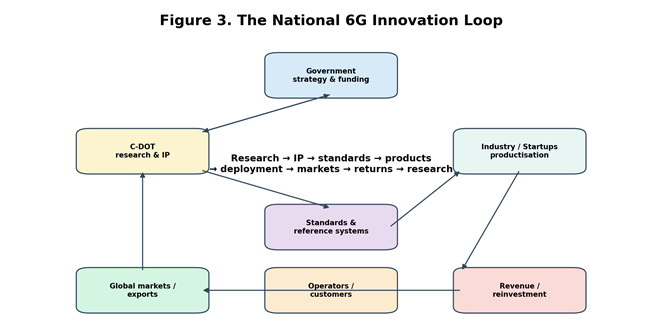
Figure 3. The National 6G Innovation Loop.
9.1 Three-Tier Technology Portfolio
- Tier I — National Strategic Technologies: Government-supported and C-DOT-led.
- Tier II — Commercially Promising Technologies: C-DOT and industry jointly productise.
- Tier III — Frontier Technologies: C-DOT, academia and partners explore high-risk future options.
9.2 Returning to H1
| Hypothesis component | Verdict |
| Significant institutional gap exists | Supported |
| Current funding/governance may make closure difficult | Strongly plausible |
| Commercial autonomy is likely necessary | Strongly indicated |
| Access to capital is likely necessary | Strongly indicated |
| Institutional reform alone makes C-DOT a global MNC equivalent | Not supported; ecosystem strategy required |
| C-DOT can become a national 6G technology anchor | Potentially yes, with institutional evolution and ecosystem scale |
9.3 Can C-DOT Take on the Global Firms?
If ‘take on’ means matching Huawei, Nokia, Ericsson or Samsung in revenue, employees, patents and global footprint, that is not a realistic objective for C-DOT as a single institution in the foreseeable future. If it means generating strategically important 6G technologies, owning globally relevant IP, influencing standards, producing deployable systems and enabling Indian companies to compete internationally, the answer is potentially yes.
9.4 Reform Roadmap
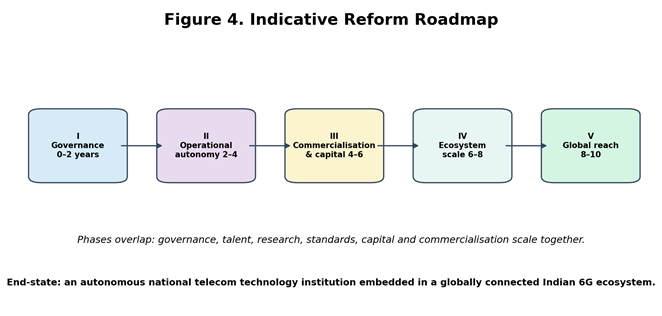
Figure 4. Indicative Reform Roadmap.
- Phase I: governance, Board, decision rights, strategic portfolios and reporting.
- Phase II: operational autonomy in recruitment, procurement and internal resource allocation.
- Phase III: commercialisation vehicle and scale-up capital.
- Phase IV: ecosystem expansion with industry, operators, academia, semiconductor and startup partners.
- Phase V: international standards leadership, licensing, exports and global partnerships.
The institutional architecture should therefore be read as an ecosystem design, not a C-DOT-centric monopoly. C-DOT is the anchor because it already possesses the mandate, technical base, national connectivity context, technology-transfer experience and government relationship required to coordinate the core technology portfolio. B6GA, TSDSI, operators, industry associations, academia, startups, satellite/space actors, manufacturers and export bodies should remain active nodes in the system. The reform succeeds when these actors can connect to a professional C-DOT technology portfolio without being forced into a single administrative hierarchy.
9.5 Final Conclusion
C-DOT already possesses an institutional nucleus from which a globally relevant Indian telecom technology ecosystem can be built. Its financial trajectory, technology-linked income, indigenous 4G/5G capability and advanced technology programmes demonstrate that the starting point is credible.
The principal challenge is conversion: research must become IP; IP must influence standards; standards must become products; products must reach customers; customers must create revenue; and revenue must help finance the next generation of research.
The reform proposed by this study is not a retreat from Government. It is a more sophisticated relationship between Government and national technology capability: Government remains the strategic owner and steward, while C-DOT gains the freedom required to make technical, personnel, partnership and commercial decisions at the speed of the technology cycle.
The central proposition is therefore: C-DOT need not become the next Huawei. It should become the institution that enables India to build what comes after Huawei.
Publication note: External ecosystem references have been refreshed to September 2026. Where an organisation’s current role is described, the paper relies on its official website or Government of India material. These references supplement, but do not replace, the core C-DOT Annual Report evidence on which the institutional diagnosis is based.