
1. Introduction
The evolution of mobile communication has historically been characterised by successive generations of technological innovation, each responding to emerging societal and industrial demands. While the first generation (1G) introduced analogue mobile voice services, the transition to second-generation (2G) systems enabled digital voice communication and text messaging. Third-generation (3G) networks extended mobile connectivity to Internet services, while fourth-generation (4G) technologies transformed broadband access and accelerated the growth of the digital economy. Fifth-generation (5G) networks have further expanded this trajectory by supporting enhanced mobile broadband, ultra-reliable low-latency communications, and massive machine-type communications, thereby laying the technological foundation for applications such as smart manufacturing, autonomous systems, artificial intelligence (AI), and the Internet of Things (IoT).
Even as 5G deployment continues across much of the world, international research has already shifted towards the next generation of mobile communications—International Mobile Telecommunications for 2030 (IMT-2030), commonly referred to as 6G. Unlike previous generational transitions that were largely driven by higher data rates or increased spectral efficiency, 6G is envisaged as an intelligent communication ecosystem integrating terrestrial and non-terrestrial networks, AI-native architectures, integrated sensing and communications, digital twins, immersive extended reality, and ubiquitous connectivity.
Recognising the long gestation period associated with wireless technologies, the International Telecommunication Union Radiocommunication Sector (ITU-R) and other international standardisation bodies have commenced studies to define the technical requirements and candidate spectrum bands for IMT-2030, with the World Radiocommunication Conference 2027 (WRC-27) expected to play a pivotal role in identifying globally harmonised spectrum for future 6G systems.
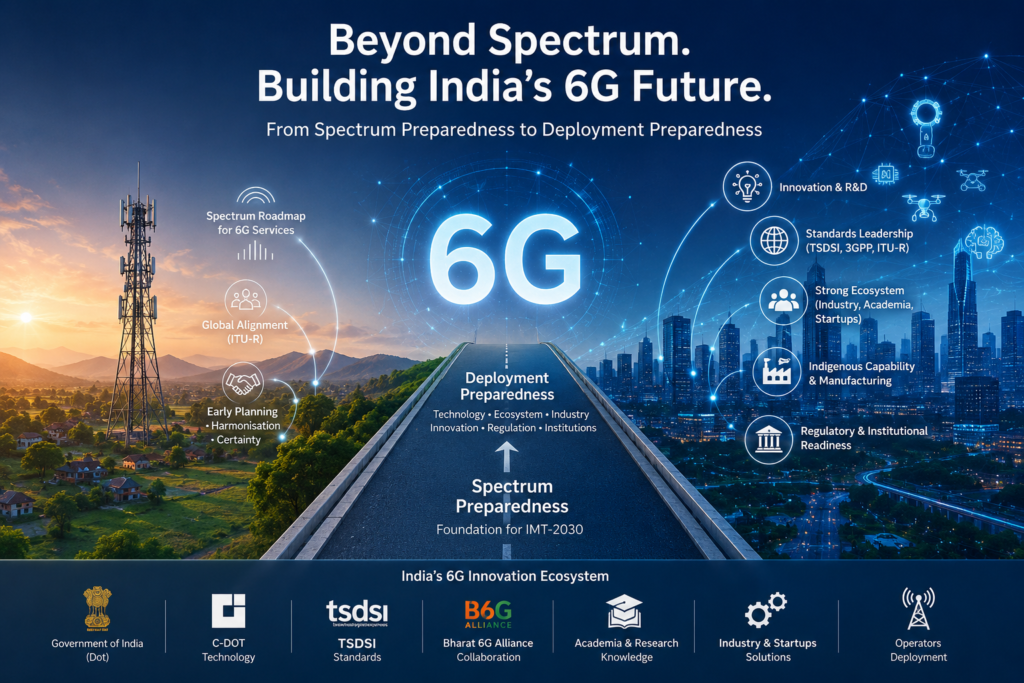
India has sought to position itself as an active participant in this global transition. The launch of the Bharat 6G Vision in 2023 articulated the country’s aspiration to become not merely an adopter of 6G technologies but a meaningful contributor to their development through indigenous research, standards participation, intellectual property creation, and technology innovation. Building upon this vision, the Department of Telecommunications (DoT) released the Spectrum Roadmap for 6G Services in December 2025, presenting a phased strategy for identifying and preparing candidate spectrum bands for future IMT-2030 services. The roadmap represents India’s first comprehensive attempt to align national spectrum planning with the evolving international trajectory towards 6G and reflects a proactive approach to long-term spectrum management.
The publication of the roadmap marks an important milestone in India’s telecommunications policy. Historically, spectrum policy has primarily focused on spectrum assignment, licensing frameworks, interference management, and efficient utilisation of radio frequencies. The 6G roadmap signifies a broader strategic orientation by positioning spectrum planning as an enabler of future digital infrastructure, technological innovation, and national competitiveness. Early spectrum preparedness is expected to facilitate equipment ecosystem development, international harmonisation, research activities, and investment planning well before commercial deployment becomes feasible.
However, spectrum planning alone does not guarantee successful deployment of a new generation of mobile communications. The transition from spectrum identification to nationwide commercial deployment encompasses a broader policy ecosystem involving technology development, standards evolution, equipment manufacturing, operator investment, migration from existing network generations, regulatory adaptation, institutional coordination, and sustainable business models. These complementary dimensions are equally important in determining whether the long-term objectives of the Bharat 6G Vision can be realised.
This paper evaluates whether the roadmap sufficiently addresses the wider policy ecosystem required to translate spectrum preparedness into successful commercial 6G deployment.
Accordingly, it distinguishes between two complementary dimensions of national preparedness:
- Spectrum Preparedness, which ensures that appropriate spectrum resources are identified, harmonised and made available for future IMT-2030 services; and
- Deployment Preparedness, which encompasses the technological, economic, regulatory and institutional ecosystem required to transform spectrum availability into commercially successful networks and services.
The Spectrum Roadmap published comprehensively addresses the first dimension by providing long-term certainty regarding candidate spectrum resources and their alignment with ongoing international studies. However, successful commercial deployment requires a sequence of additional policy interventions that extend beyond the scope of spectrum planning.
2. Conceptual Framework
The chronological activities from conceiving to the final deployment envisaged as in the framework in Fig 1.
In the previous generations, spectrum assignment was often viewed as the principal regulatory milestone. But in 6G deployment is expected to evolve through an iterative interaction between spectrum planning, international standards development, technological innovation and commercial implementation- a comprehensive development.

Figure 1. Conceptual Framework: From Spectrum Preparedness to Commercial 6G Deployment
3. Domain I – Spectrum Preparedness
3.1 Building the Foundation for IMT-2030 through the publication of Spectrum Roadmap.
Historically, spectrum policy in India has largely focused on licensing, assignment, interference management and efficient utilisation of radio-frequency resources. Spectrum is no longer viewed merely as a regulatory resource to be auctioned and assigned among competing users, but increasingly as an enabling platform for future digital infrastructure, industrial innovation and national technological capability, facilitate research activities and promote early ecosystem development. The scope of the roadmap can be captured as:
- Alignment with International Standardisation: Given India’s active participation in these international processes, the roadmap may reasonably be viewed as reflecting the prevailing direction of global spectrum studies and the candidate spectrum bands identified in the roadmap are broadly consistent with the evolving international consensus for IMT-2030.
- Invest friendly: It provides a structured time horizon extending from immediate preparatory activities to long-term commercial deployment.
- Inter-operativity and economies of scale: The roadmap strengthens India’s engagement with international spectrum harmonisation efforts by aligning national planning with ongoing ITU-R studies and future WRC deliberations.
- Certainty for researchers and equipment developers: The roadmap recognises the growing importance of emerging spectrum domains, including upper mid-band, millimetre-wave and higher-frequency bands expected to support future IMT-2030 services.
- Complements the Bharat 6G Vision: The roadmap complements the broader objectives articulated in the Bharat 6G Vision by establishing the spectrum foundation upon which future technological and commercial developments may be built.
3.2 International Approach
On international level, spectrum planning is generally treated as one component of a broader national strategy rather than as an isolated regulatory exercise:
- In the European Union, policy initiatives increasingly combine spectrum planning with industrial competitiveness, collaborative research and innovation funding.
- The United States emphasises technology leadership, commercial innovation and private-sector investment.
- China integrates spectrum planning within a broader framework of state-supported industrial development and technology leadership.
- Japan and the Republic of Korea similarly link spectrum policy with advanced manufacturing, digital industries and export competitiveness.
They all share a common characteristic: Spectrum planning is embedded within a wider policy architecture supporting technology development, industrial capability and commercial deployment.
3.3 Towards deployment.
The roadmap successfully establishes the first layer of national 6G preparedness—namely, spectrum preparedness. The subsequent challenge is to integrate this foundation with complementary policy measures addressing technology development, economic viability, migration from existing networks, regulatory evolution and institutional coordination. These dimensions collectively constitute what this paper describes as deployment preparedness, which forms the focus of the subsequent sections.
4. Domain II — Deployment Preparedness
4.1 The Deployment Ecosystem: Beyond Spectrum
At this next stage, the principal challenges shift from spectrum management to technology development, commercial viability and ecosystem creation.
i) Proving Technical Capability: First, technological readiness becomes essential to translate the international standards mature into commercially deployable products, including chipsets, radio access equipment, optical transport systems, cloud-native network software and AI-enabled network management platforms.
ii) Commercial sustainability: Second, commercial deployment depends upon a viable economic ecosystem. Mobile network operators must evaluate investment requirements, anticipated revenue streams, enterprise demand and long-term returns on capital expenditure.
iii) Migration: Third, migration from existing network generations requires careful planning. By the time IMT-2030 services become commercially available, many countries—including India—will still be expanding or monetising their Standalone 5G infrastructure which will ensure both versions will coexist.
iv) Ecosystem development: Fourth, successful implementation depends upon an innovation ecosystem capable of translating research into commercial products. This includes sustained investment in research and development, participation in international standards, intellectual property generation, advanced manufacturing capabilities and collaboration among government, academia and industry.
v) Regulatory maturity: Finally, regulatory and institutional preparedness become increasingly important as future networks integrate terrestrial systems, satellites, artificial intelligence and sensing technologies. Emerging issues relating to licensing, cybersecurity, data governance, interoperability and institutional coordination require policy frameworks extending beyond conventional spectrum regulation.
4.2 Towards Deployment
What are the complementary policy measures that may be required to translate spectrum preparedness into successful commercial implementation?
The following five dimensions are linked to the deployment preparedness:
- Economic readiness;
- Migration from 5G to 6G;
- Indigenous innovation and industrial capability;
- Regulatory preparedness; and
- Institutional coordination.
Together, these dimensions constitute the broader deployment ecosystem that complements the Spectrum Roadmap and supports the long-term realisation of the Bharat 6G Vision. These are complementary policy domains that collectively determine the pace, scale and sustainability of commercial 6G deployment.
4.2.1 Economic Readiness: The Commercial Foundation for 6G
While spectrum availability enables network deployment, the decision to invest ultimately rests upon whether operators can justify the substantial capital expenditure required for nationwide implementation.
6G is expected to emerge during a period when many operators around the world are still recovering investments made in Standalone 5G infrastructure. Consequently, the commercial success of IMT-2030 will depend not merely upon technological superiority but upon the existence of sustainable business models capable of generating acceptable returns on investment.
India presents a distinctive economic context. The country possesses one of the world’s largest mobile subscriber bases, yet average revenue per user (ARPU) remains comparatively modest by international standards. Over the past decade, intense market competition and low consumer tariffs have significantly constrained operator profitability even as network investment has accelerated. The rapid nationwide rollout of 5G demonstrates implies that substantial investments in existing infrastructure are yet to realise their full commercial potential. It boils down to three important questions.
I) First, what economic conditions will justify a new investment cycle for IMT-2030 while significant 5G assets including spectrum remain in service? It is a fact that the timing and scale of commercial demand for these services remain uncertain.
ii) Second, what role will enterprise demand play in the commercial evolution of 6G? Previous generations were predominantly consumer-driven (more data), whereas many anticipated 6G applications—including industrial automation, digital twins, precision healthcare and intelligent transportation—are expected to derive value from enterprise and public-sector deployments. The pace of commercial rollout may therefore depend as much on the digital transformation of industries as on consumer adoption.
iii) Third, what investment models will encourage sustainable deployment? Publicly available policy initiatives in several advanced economies increasingly recognise that next-generation mobile networks require favourable investment environments, collaborative research programmes and innovation ecosystems that reduce commercial risk. Economic readiness ultimately depends upon the interaction between technology maturity, market demand, investment capability and regulatory stability. It should have sustainable investment while preserving the affordability of the service.
International experience on Economic Readiness
Within the European Union, 6G policy discussions increasingly link communications infrastructure with industrial competitiveness, digital sovereignty and collaborative research programmes. Considerable emphasis is placed on ensuring that future networks support manufacturing, healthcare, transportation and energy systems rather than serving solely as enhanced mobile broadband platforms.
In the United States, commercial viability remains central to the evolution of 6G. Industry-led initiatives focus on creating market-driven innovation ecosystems in which investment decisions are guided by enterprise demand, technological differentiation and sustainable business opportunities.
China has adopted a different approach by integrating 6G development into broader national industrial policy. Public investment, coordinated research programmes and long-term technology planning seek to accelerate innovation while strengthening domestic industrial capability.
Japan and the Republic of Korea similarly regard 6G as an instrument for reinforcing advanced manufacturing, robotics and digital industries. In these countries, communications policy is closely aligned with national industrial competitiveness.
Although these approaches differ substantially in institutional arrangements and market structures, they share a common characteristic: economic preparedness is treated as a strategic policy objective rather than an outcome expected to emerge automatically from spectrum availability.
4.2.2 Migration Readiness: Bridging the Transition from 5G to 6G
6G is being conceived at a time when Standalone 5G networks are still under deployment and commercial monetisation. Consequently, migration from 5G to 6G is unlikely to involve wholesale replacement of existing infrastructure. Rather, it is expected to be characterised by phased technological evolution, infrastructure reuse and long-term coexistence. Migration planning determines how existing infrastructure, investments and operational capabilities evolve towards the next generation.
Migration strategies should therefore encourage:
- Progressive software-driven evolution where feasible;
- Maximum reuse of transport and fibre infrastructure;
- Interoperability between successive network generations;
- Gradual introduction of new radio capabilities; and
- Investment protection through phased deployment.
Such an approach promotes financial sustainability while reducing unnecessary duplication of network assets.
Phased Migration: The 5G-Advanced system provides operators with an opportunity to extract greater value from existing infrastructure while progressively introducing technologies that are expected to mature further within the 6G ecosystem. Internationally, 5G-Advanced is increasingly viewed as the technological bridge between current Standalone 5G deployments and future IMT-2030 systems. Many capabilities expected to characterise early 6G networks—including AI-assisted network optimisation, integrated sensing, enhanced automation and improved energy efficiency—are already being introduced incrementally through successive 3GPP releases.
Operators are likely to evaluate several interrelated factors before embarking upon large-scale deployment, including:
- Maturity of international standards;
- Availability of interoperable equipment;
- Enterprise demand for advanced services;
- Lifecycle of existing 5G investments;
- Expected return on additional capital expenditure; and
- Availability of compatible devices within the consumer ecosystem.
Accordingly, commercial deployment is expected to occur gradually, initially concentrating on high-value enterprise applications, industrial corridors, research environments and densely connected urban ecosystems before expanding towards broader nationwide coverage.
International Experience on Migration of tech:
- Within Europe, Beyond-5G initiatives emphasise continuity between successive generations while encouraging progressive introduction of advanced network capabilities.
- Similar perspectives are reflected in the United States, Japan and the Republic of Korea, where policy discussions increasingly describe 6G as the natural evolution of cloud-native and software-defined network architectures rather than an entirely independent communications platform.
- China likewise appears to view 6G development within a long-term technological continuum, integrating ongoing 5G expansion with future research programmes rather than treating the two generations as competing technologies.
India should use the migration as an opportunity to ensure that the substantial investments already made in India’s 5G ecosystem become the foundation upon which future IMT-2030 networks are progressively built.
4.2.3 Innovation Readiness: Building the National 6G Innovation Ecosystem
The long-term success of 6G will ultimately depend upon a nation’s capacity to generate technology, participate in global standardisation, commercialise innovation and develop competitive industrial capabilities. In this context, innovation readiness constitutes a critical pillar of deployment preparedness. The evolution from GSM to 5G demonstrates that countries possessing mature innovation ecosystems have consistently exercised greater influence over technology standards and global telecommunications markets.
India has recognised this reality through the Bharat 6G Vision, which articulates an aspiration not only to deploy 6G networks but also to contribute meaningfully to their development. Achieving this objective, however, requires more than scientific research alone. It depends upon the development of an integrated innovation ecosystem capable of transforming research outcomes into commercially deployable technologies.
i) Fundamental research: Research undertaken by universities, national laboratories and specialised research organisations provides the scientific basis for future radio technologies, network architectures, artificial intelligence applications and emerging communication paradigms.
ii) Technology development and prototyping: Research findings must evolve into reference designs, testbeds, proof-of-concept systems and experimental platforms capable of validating new technologies under realistic operating conditions.
iii) Participation in international standards development: Contributions to organisations such as the ITU-R and 3GPP enable researchers and industries to influence technical specifications while ensuring that domestic innovations become part of globally interoperable communication systems.
iv) Intellectual property generation and commercialisation: Patents, particularly those contributing to international standards, provide both technological recognition and opportunities for long-term industrial competitiveness. Equally important is the ability to translate patented technologies into commercially viable products and services.
v) Advanced manufacturing capabilities: Startup ecosystems, investment mechanisms and industry partnerships capable of transforming technological innovations into market-ready products.
These components are mutually reinforcing. Weakness in any one element may constrain the effectiveness of the overall innovation ecosystem. India has initiated several institutional mechanisms intended to strengthen national preparedness for 6G innovation, such as:
- The Bharat 6G Vision provides the strategic direction by articulating long-term national objectives for technology leadership, standards participation and indigenous capability.
- The DoT, TEC, TSDSI and C-DOT continue to play important roles in telecommunications research, standards development, testing and technology demonstration.
- The establishment of the Bharat 6G Alliance (B6GA) brings together government agencies, academia, telecommunications service providers, equipment manufacturers, startups and research institutions with the objective of promoting collaborative innovation, standards participation and international cooperation.
- Complementing these initiatives are research activities undertaken by the Indian Institutes of Technology (IITs), the Indian Institute of Science (IISc), other universities, startup ecosystems and industry-led research programmes. Collectively, these institutions provide the foundation of India’s emerging 6G innovation architecture.
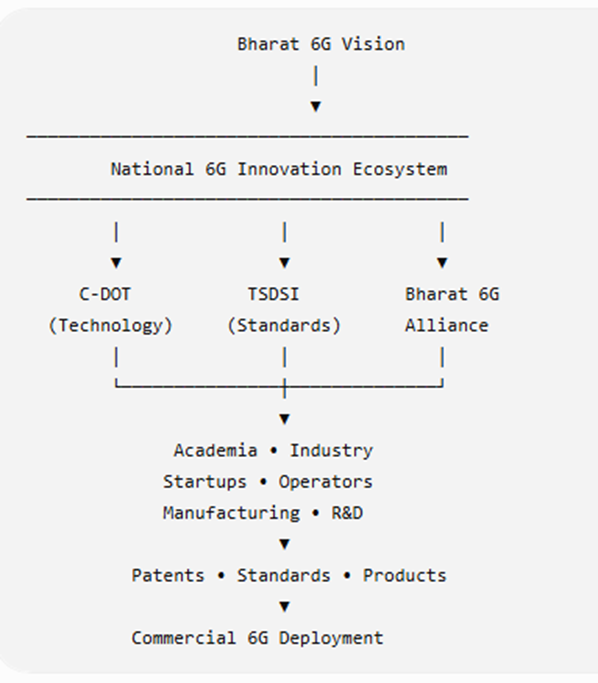
Fig 2: India’s 6G Innovation Ecosystem
International experience suggests that collaborative platforms create value when they facilitate measurable technological outcomes. Such outcomes may include sustained research programmes, standards contributions, intellectual property generation, successful technology transfer, startup creation, prototype development and commercial deployment of indigenous products.
Accordingly, the long-term effectiveness of any national innovation ecosystem is ultimately reflected not merely by the number of participating organisations or collaborative agreements, but by its capacity to convert research into deployable technologies and internationally recognised innovations.
How should the effectiveness of India’s emerging 6G innovation ecosystem be assessed?
Publicly observable indicators can provide an evidence-based framework for evaluating long-term progress.
These indicators may include:
- participation in international standardisation activities;
- technical contributions accepted by global standards organisations;
- patents and intellectual property generation;
- technology transfer from laboratories to industry;
- development of indigenous prototypes and reference implementations;
- growth of deep-technology startups;
- expansion of domestic manufacturing capability; and
- successful commercialisation of research outcomes.
Such indicators emphasise measurable outcomes rather than institutional activity alone. Innovation must ultimately translate into manufacturing capability and resilient supply chains.
Within this broader framework, the Bharat 6G Alliance occupies a distinctive position- connecting the various components of India’s innovation ecosystem.
The long-term impact of the Alliance should therefore be evaluated not merely by the number of Memoranda of Understanding concluded with international organisations, but by the extent to which these collaborations translate into tangible technological outcomes, including standards contributions, indigenous innovations, intellectual property generation and commercial products.
Viewed from this perspective, the Bharat 6G Alliance represents an enabling institution within India’s broader innovation architecture. Its ultimate contribution will depend upon its ability to transform collaborative networks into sustained technological capability and internationally competitive innovation.
From Standards Acceptance to Global Adoption
Participation in international standardisation is an essential step towards technological leadership, but acceptance of a technical contribution does not by itself ensure widespread deployment. International standards frequently include optional or implementation-dependent features, allowing equipment manufacturers and operators to determine their adoption based on technical merit, commercial demand and deployment priorities.
The experience of previous generations demonstrates that the long-term influence of a technological contribution depends not merely on its inclusion within the standard, but on its subsequent adoption across global products and networks.
India’s 6G innovation strategy should therefore aspire not only to increase the number of standards contributions, but also to develop technologies that address globally relevant challenges and become integral to widely implemented international standards. This would maximise both the technological impact of Indian innovation and the commercial value of its intellectual property.
4.2.4 Regulatory Readiness: Preparing the Governance Framework for IMT-2030
The evolution of mobile communications has historically required corresponding evolution in telecommunications regulation. While previous generations primarily focused on licensing, spectrum assignment, quality of service and competition, IMT-2030 is expected to introduce technologies whose regulatory implications extend far beyond conventional telecommunications policy.
Future 6G networks are anticipated to integrate terrestrial and non-terrestrial systems, artificial intelligence, cloud-native architectures, integrated sensing and communications, edge computing and highly distributed digital infrastructures. Similarly, highly distributed cloud-native architectures are expected to increase the importance of cybersecurity, resilience and cross-sector coordination These developments are expected to blur traditional regulatory boundaries between telecommunications, information technology, satellite communications, cybersecurity and data governance.
Consequently, deployment preparedness requires a regulatory framework capable of supporting technological convergence while preserving interoperability, security and public confidence.
The following policy priorities are already identifiable in the international arena:
- Governance of AI-assisted network operations;
- Integration of terrestrial and non-terrestrial communication systems;
- Evolution of licensing frameworks for converged networks;
- Cybersecurity and network resilience;
- Privacy and responsible management of sensing-related information;
- Interoperability across multiple communication platforms; and
- Regulatory support for innovation through technology-neutral frameworks.
Such regulatory preparedness should be viewed as a continuing process rather than a single legislative intervention. Close interaction between technological evolution, international standards and domestic regulatory policy will remain essential throughout the transition to commercial 6G deployment.
Complementary regulatory evolution will be required to address the broader technological convergence expected to characterise future communication networks such as 6G. Accordingly, regulatory readiness represents another important pillar of deployment preparedness, complementing—but extending beyond—the spectrum planning objectives of the Spectrum Roadmap.
4.2.5 Institutional Readiness: Coordinating the National 6G Ecosystem
While technology, spectrum and regulation provide the technical and policy foundations for future networks, successful national implementation ultimately depends upon institutional capability. The transition towards IMT-2030 is expected to require substantially broader coordination involving research organisations, universities, standards bodies, equipment manufacturers, startups, telecommunications service providers and multiple government departments.
India has already established several important institutions supporting the country’s long-term 6G aspirations.
- The Bharat 6G Vision provides the strategic direction.
- The DoT provides overall policy leadership.
- The TEC contributes to standards development and technical evaluation.
- TSDSI as a Standard Developing Organisation (SDO) participates in 3GPP and International Representation.
- C-DOT continues to play a significant role in telecommunications research and technology development.
- The Bharat 6G Alliance facilitates collaboration among government, industry and academia.
- Universities, research institutions, startups, telecommunications operators and equipment manufacturers contribute to the broader innovation ecosystem.
As deployment approaches, several governance questions naturally emerge:
- How will progress towards national 6G objectives be periodically assessed?
- How will research priorities be aligned with international standards?
- How will emerging policy issues requiring inter-ministerial coordination be addressed?
- How will industry, academia and government collectively respond to technological developments occurring between successive international standardisation milestones?
The existence of multiple institutions, however, does not by itself guarantee coordinated implementation. Institutional readiness should be understood not merely as the presence of capable organisations, but as the effectiveness of coordination among them.
India’s institutional landscape for 6G has evolved organically through organisations with distinct mandates. As deployment approaches, the principal governance challenge is likely to shift from institutional creation to institutional integration. Periodic policy review, coordinated milestones, and a common national implementation roadmap may therefore become increasingly important to ensure that research, standards, regulation and commercial deployment evolve in a synchronised manner.
The initiatives already taken may be further strengthened through institutional mechanisms that facilitate periodic review, cross-sector coordination and monitoring of long-term national objectives.
Such mechanisms need not create additional administrative structures. Rather, they should enable continuous interaction among existing institutions while ensuring that spectrum planning, research, innovation, regulation and industrial development evolve in a coordinated manner.
5. Integrating Spectrum Preparedness with Deployment Preparedness: Towards a National 6G Deployment Framework
The preceding sections have argued that India’s spectrum preparedness represents only the first stage of national 6G preparedness. Commercial deployment depends upon the successful convergence of multiple policy domains that evolve over different time horizons and involve a diverse range of public and private stakeholders.
The challenge before policymakers is therefore no longer limited to preparing spectrum; it is to integrate spectrum preparedness with deployment preparedness through a coherent as a National 6G Deployment Framework, complementing rather than replacing the existing Spectrum Roadmap.
5.2 Integrating Existing National Initiatives
India has already established several strategic initiatives supporting different dimensions of 6G preparedness.
| Institutional Pillar | Primary Function |
| Bharat 6G Vision | National strategy and policy direction |
| Spectrum Roadmap | Spectrum preparedness |
| C-DOT | Technology research and development |
| TSDSI | Standards development and international representation |
| Bharat 6G Alliance | Ecosystem coordination and collaboration |
The Department of Telecommunications, TEC, C-DOT, TSDSI, the Bharat 6G Alliance, academic institutions, telecommunications operators, equipment manufacturers and startups together constitute the institutional ecosystem supporting India’s long-term 6G ambitions.
The next phase of policy development therefore lies not in creating entirely new institutional structures, but in strengthening coordination among existing initiatives while ensuring that their objectives evolve in a mutually reinforcing manner.
5.3 Principles of a National 6G Deployment Framework
Based on the foregoing analysis, a complementary deployment framework may be guided by five broad principles.
- First, spectrum planning should continue to remain aligned with evolving international standards while maintaining flexibility to accommodate future technological developments.
- Second, deployment policies should promote commercially sustainable investment by supporting phased migration from existing 5G infrastructure, encouraging infrastructure reuse and fostering enterprise-driven demand for advanced digital services.
- Third, innovation policies should strengthen the national research ecosystem through standards participation, intellectual property generation, technology commercialisation and advanced manufacturing capability.
- Fourth, regulatory frameworks should progressively evolve to accommodate emerging technologies including artificial intelligence, integrated sensing, non-terrestrial networks and cloud-native architectures while preserving security, interoperability and technology neutrality.
- Finally, institutional coordination should facilitate continuous interaction among government, academia, industry and standards organisations, enabling periodic review of national objectives and timely adaptation to international technological developments.
5.4 From Preparedness to Deployment
The evolution of telecommunications policy has historically followed successive stages of technological maturity. During earlier generations, spectrum assignment often represented the principal regulatory milestone preceding commercial deployment. The complexity of IMT-2030 suggests that this paradigm is evolving.
Future 6G networks will depend upon the convergence of communications technologies, artificial intelligence, cloud computing, advanced manufacturing, digital infrastructure and international standardisation. Consequently, national preparedness increasingly extends beyond spectrum availability towards integrated ecosystem development.
India has already taken significant steps by establishing a long-term vision, initiating spectrum preparedness and promoting collaborative innovation. The next policy opportunity lies in integrating these initiatives into a coherent deployment framework capable of supporting the commercial realisation of IMT-2030 services.
Such an approach does not imply that existing policies are incomplete. Rather, it recognises that spectrum preparedness and deployment preparedness constitute successive stages within the same policy continuum.
Accordingly, the proposed National 6G Deployment Framework should be viewed as the natural evolution of India’s telecommunications policy—from preparing the spectrum required for future networks towards preparing the broader ecosystem necessary for their successful deployment.
6. Conclusion
The emergence of IMT-2030 (6G) represents more than the introduction of another generation of mobile communications. It marks the evolution of telecommunications from a predominantly connectivity-oriented infrastructure towards an intelligent digital ecosystem integrating communications, artificial intelligence, sensing, cloud computing, non-terrestrial networks and advanced industrial applications. Such an evolution requires policy frameworks that extend beyond traditional spectrum management and embrace the broader technological, economic and institutional dimensions of national preparedness.
India’s Spectrum Roadmap for 6G Services, released in December 2025, represents a significant milestone in this direction. By identifying candidate spectrum bands, aligning national planning with ongoing international studies and providing long-term regulatory certainty, the roadmap establishes a robust foundation for spectrum preparedness. Given India’s active participation in the ITU-R studies leading to IMT-2030 and the anticipated outcomes of WRC-27, the roadmap reflects a proactive approach that positions the country to participate effectively in the evolving global 6G ecosystem.
This paper has proceeded on the premise that the roadmap successfully fulfils its intended objective of preparing the national spectrum landscape for future IMT-2030 services. Rather than questioning the technical suitability of the identified spectrum bands, it has examined a broader policy question: whether spectrum preparedness alone is sufficient to enable successful commercial deployment of 6G networks.
The analysis suggests that spectrum preparedness, while indispensable, represents only the first layer of national 6G preparedness. Commercial deployment depends upon the convergence of several complementary policy domains, including economic readiness, migration from existing 5G networks, innovation capability, regulatory evolution and institutional coordination. These dimensions collectively determine whether spectrum resources can be transformed into commercially viable networks, internationally competitive technologies and sustainable digital infrastructure.
The paper therefore distinguishes between Spectrum Preparedness and Deployment Preparedness as two complementary domains within the national 6G policy architecture. The first establishes the regulatory foundation through spectrum planning and international harmonisation. The second focuses on creating the technological, economic, industrial and governance ecosystem necessary for commercial implementation. These domains should not be viewed as alternatives, but as successive stages of the same national preparedness continuum.
An equally important observation emerging from this study is that India has already established the principal institutional pillars required for long-term 6G development. The Bharat 6G Vision provides strategic direction. The Spectrum Roadmap for 6G Services establishes spectrum preparedness. The Bharat 6G Alliance, together with the Department of Telecommunications, TEC, TSDSI, C-DOT, academic institutions, telecommunications service providers, equipment manufacturers and startups, contributes to an emerging innovation ecosystem. These initiatives represent substantial progress towards India’s long-term aspiration of becoming a meaningful contributor to global 6G development.
The next stage of policy evolution therefore lies not in replacing these initiatives but in strengthening their integration. This paper proposes that the natural progression of India’s 6G policy is the development of a National 6G Deployment Framework that complements the existing Spectrum Roadmap by integrating spectrum preparedness with deployment preparedness. Such a framework would promote coordinated evolution across the five policy pillars identified in this study—economic readiness, migration readiness, innovation readiness, regulatory readiness and institutional readiness—while remaining fully aligned with the objectives of the Bharat 6G Vision.
This proposal recognises the Spectrum roadmap as a foundational policy instrument whose effectiveness will be enhanced through complementary measures supporting technology development, commercial deployment and ecosystem integration. This relationship is evolutionary: the Spectrum Roadmap establishes the regulatory foundation, while the proposed Deployment Framework extends its implementation into the broader domains of technology, economics, governance and innovation.
As the international community progresses towards IMT-2030 through the ongoing work of the ITU-R, WRC-27 and 3GPP, national preparedness will increasingly be measured not only by the availability of harmonised spectrum but also by the ability to translate that spectrum into globally competitive technologies, resilient digital infrastructure and sustainable economic value. India’s early initiatives in vision setting, spectrum planning and collaborative innovation have created a strong platform from which to pursue these objectives.
Ultimately, the success of India’s 6G journey will depend not on any single policy instrument but on the coordinated evolution of vision, spectrum, innovation, regulation, economics and institutional governance. Viewed in this broader context, spectrum preparedness is not the destination of India’s 6G strategy—Spectrum prepares the frequencies. Deployment preparedness prepares the nation. Both are indispensable for India’s successful transition to IMT-2030.