
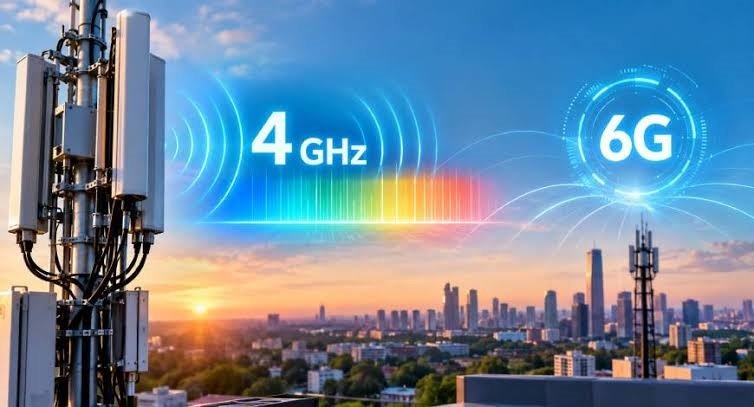
The 4400–4800 MHz band is emerging as an important candidate for future IMT-2030/6G deployment. Under WRC-27 Agenda Item 1.7, ITU-R is studying the possibility of identifying all or parts of 4400–4800 MHz for IMT in Regions 1 and 3, while protecting existing primary services and adjacent-band operations.
For India, the band assumes particular significance because it could provide a large and relatively attractive mid-band spectrum block for 6G. India’s current spectrum planning document identifies 4400–4800 MHz as a band to be studied for possible IMT identification through WRC-27, with possible subsequent refarming for IMT services in India. At the same time, India plans to make 300 MHz in 6725–7025 MHz available for mobile services during 2027–2030.
The special Indian situation concerning satellite use
An important consideration for India is the relationship between 4500–4800 MHz and 6725–7025 MHz.
Under the ITU-R Appendix 30B FSS Plan, these two bands form a paired 6/4 GHz satellite link:
- 6725–7025 MHz — Earth-to-space uplink
- 4500–4800 MHz — space-to-Earth downlink
The pairing is explicitly recognised in the ITU-R Appendix 30B documentation.
India has now indicated that 6725–7025 MHz is planned to be made available for terrestrial mobile use during 2027–2030. Consequently, from the standpoint of India’s future national spectrum architecture, the corresponding 4500–4800 MHz satellite downlink requirement becomes considerably less compelling if the associated Indian satellite Plan use is discontinued as part of this transition.
This could materially strengthen India’s case for using 4500–4800 MHz for IMT/6G.
It is nevertheless important to distinguish between national refarming and international regulatory rights. India’s decision to vacate 6725–7025 MHz does not, by itself, remove the international FSS allocation or Appendix 30B rights in 4500–4800 MHz. The relevant Indian satellite assignments/Plan arrangements would have to be appropriately dealt with under the ITU regulatory framework. Thus, the argument should be presented as an India-specific reduction in the practical incumbent requirement, rather than as an automatic extinction of the international satellite allocation.
Implication for India’s WRC-27 position
This creates an interesting strategic situation for India.
At the international level, the 4500–4800 MHz FSS downlink remains one of the services that has to be considered in the ITU-R sharing studies. However, domestically, India is simultaneously planning to move the paired 6725–7025 MHz uplink spectrum towards terrestrial mobile use by 2030.
Therefore, India could reasonably argue that:
The long-term Indian requirement for the 4500–4800 MHz FSS downlink should be reassessed in conjunction with the planned release of its paired 6725–7025 MHz uplink band.
This would strengthen India’s case for obtaining a substantial portion of 4400–4800 MHz for IMT, subject to protection of genuinely continuing incumbent services.
APT regional consideration
India’s position must nevertheless be coordinated with the wider APT/APG-27 process. The Asia-Pacific region has administrations with substantially different incumbent-service situations. Consequently, India should seek an APT position that permits IMT identification of a substantial part of 4400–4800 MHz, while allowing appropriate national flexibility where incumbent services genuinely continue to require protection.
India’s participation in the AI 1.7 drafting process gives it an opportunity to ensure that the regional position reflects the different national circumstances within APT, rather than imposing a uniform restriction based on incumbent uses that may not exist, or may be declining, in India.
Advantages for India
1. Large mid-band resource:
The potential availability of up to 400 MHz provides a substantial capacity layer for future 6G.
2. Good coverage-capacity balance:
Propagation at 4.4–4.8 GHz is more favourable than at much higher 6G frequencies, while offering considerably greater capacity than traditional low-band spectrum.
3. Reduced Indian FSS constraint:
If India proceeds with the planned transition of 6725–7025 MHz to mobile use and correspondingly restructures its Appendix 30B satellite requirements, the associated 4500–4800 MHz downlink requirement could cease to be a significant long-term domestic constraint.
4. Spectrum harmonisation:
An APT-supported IMT identification would improve the prospects of an equipment, chipset and handset ecosystem covering major Asian markets.
5. Strategic 6G capacity:
The band could become an important complement to India’s existing 3.5 GHz spectrum and future 6 GHz/other 6G spectrum resources.
Issues that remain
The disappearance or reduction of India’s own FSS requirement does not resolve all the international issues. ITU-R studies continue to consider:
- Fixed Service versus IMT;
- Aeronautical Mobile Service;
- Maritime Mobile Service;
- FSS in 4500–4800 MHz;
- protection of aeronautical systems in the adjacent 4200–4400 MHz band;
- aeronautical telemetry and other incumbent operations; and
- scientific/radio-astronomy considerations around the upper edge of the band.
Consequently, India’s situation is somewhat different from the global situation: the FSS issue may be substantially less restrictive for India than for some other administrations, but aviation, fixed-service and other international sharing issues remain.
Likely scenario for India
India should therefore pursue a proactive but flexible strategy at WRC-27.
The preferred outcome would be an IMT identification covering the maximum technically feasible portion of 4400–4800 MHz, with regulatory conditions that permit meaningful national deployment.
Strategic importance of an APT regional consensus
For India, the outcome of the APT/APG-27 process may be almost as important as the formal WRC-27 decision itself. An IMT identification by WRC-27 would create the international regulatory possibility for deployment, but it would not by itself guarantee an economically viable 6G ecosystem in India.
The 4400–4800 MHz band is a potential regional harmonisation band. If APT administrations arrive at a common or substantially aligned position on the band, India would have a much stronger basis for national adoption. Harmonisation across the Asia-Pacific region would improve the prospects of common equipment, chipsets and terminals, create economies of scale and facilitate regional roaming and interoperability.
Conversely, if APG-27 is unable to achieve a meaningful regional consensus, India could face a difficult implementation situation even if WRC-27 ultimately identifies the band for IMT. India might then have the regulatory freedom to use the spectrum, but without sufficient regional ecosystem support the commercial deployment of 6G in this band could become fragmented and more expensive.
This makes the APT position strategically important for India. The objective should therefore not merely be to obtain a favourable WRC-27 footnote or IMT identification. India should work towards an APT consensus supporting a substantial, contiguous and practically usable portion of 4400–4800 MHz for IMT, with technically justified protection conditions for incumbent services.
A three-level test for India’s 4.4–4.8 GHz strategy
The eventual success of this band in India can therefore be viewed as requiring three levels of alignment:
1. ITU/WRC-27 level — Regulatory feasibility
The band, or a substantial portion of it, must receive an IMT identification with workable technical conditions.
2. APT/APG level — Regional harmonisation
The Asia-Pacific administrations should reach sufficient commonality on the frequency range and technical framework to support an ecosystem and avoid fragmentation.
3. Indian national level — Practical availability
India must resolve its incumbent-service requirements, including the future of its 4500–4800 MHz FSS requirement in conjunction with the planned release of 6725–7025 MHz, and establish a domestic refarming and deployment plan.
Only when these three levels converge can 4400–4800 MHz become a realistically deployable 6G band for India.
Strategic implication
India should consequently treat APT consensus as a strategic objective rather than simply a regional procedural matter. India’s participation in APG-27 should seek to bridge the differing positions within the Asia-Pacific region and promote a compromise that permits IMT use while accommodating administrations with continuing incumbent requirements.
A particularly useful outcome for India would be an APT position supporting the largest technically feasible contiguous block, rather than insisting on an unrestricted 400 MHz identification if that becomes an obstacle to regional consensus.
If such a consensus cannot be achieved, India should retain alternative 6G spectrum options and avoid making 4400–4800 MHz the sole foundation of its 6G mid-band strategy.
Overall assessment
The strategic equation for India can therefore be expressed simply:
- WRC-27 identification makes the band legally possible.
- APT consensus makes the band commercially and technically viable.
- Indian refarming makes the band nationally deployable.
India’s objective should be to achieve all three.
The planned transition of 6725–7025 MHz to mobile use by 2030 strengthens India’s domestic case for reducing the corresponding FSS requirement in 4500–4800 MHz. However, this advantage will have its full strategic value only if India can simultaneously secure sufficient APT convergence on the 4400–4800 MHz IMT framework.
Conclusion
The planned Indian transition of 6725–7025 MHz to terrestrial mobile use by 2030 materially changes the domestic context of 4500–4800 MHz. Since these bands constitute the uplink/downlink pair of the Appendix 30B 6/4 GHz FSS Plan, India’s future requirement for the corresponding satellite downlink can potentially diminish substantially.
This gives India a stronger domestic case for seeking 4400–4800 MHz, or a substantial part thereof, for IMT-2030/6G.
The qualification is that this is not automatically equivalent to the international disappearance of the FSS incumbent. India would need to appropriately address its satellite Plan assignments and regulatory rights. Nevertheless, if that process is completed, India could enter WRC-27 with a particularly strong national case: the country would be seeking to re-farm a band whose paired satellite uplink is itself being relinquished for terrestrial mobile use.
The strategic objective for India should therefore be not merely to obtain an IMT identification at WRC-27, but to secure a practically usable and sufficiently large contiguous mid-band block, while using the country’s planned 6725–7025 MHz transition to support the case for reducing the corresponding 4500–4800 MHz satellite requirement.