
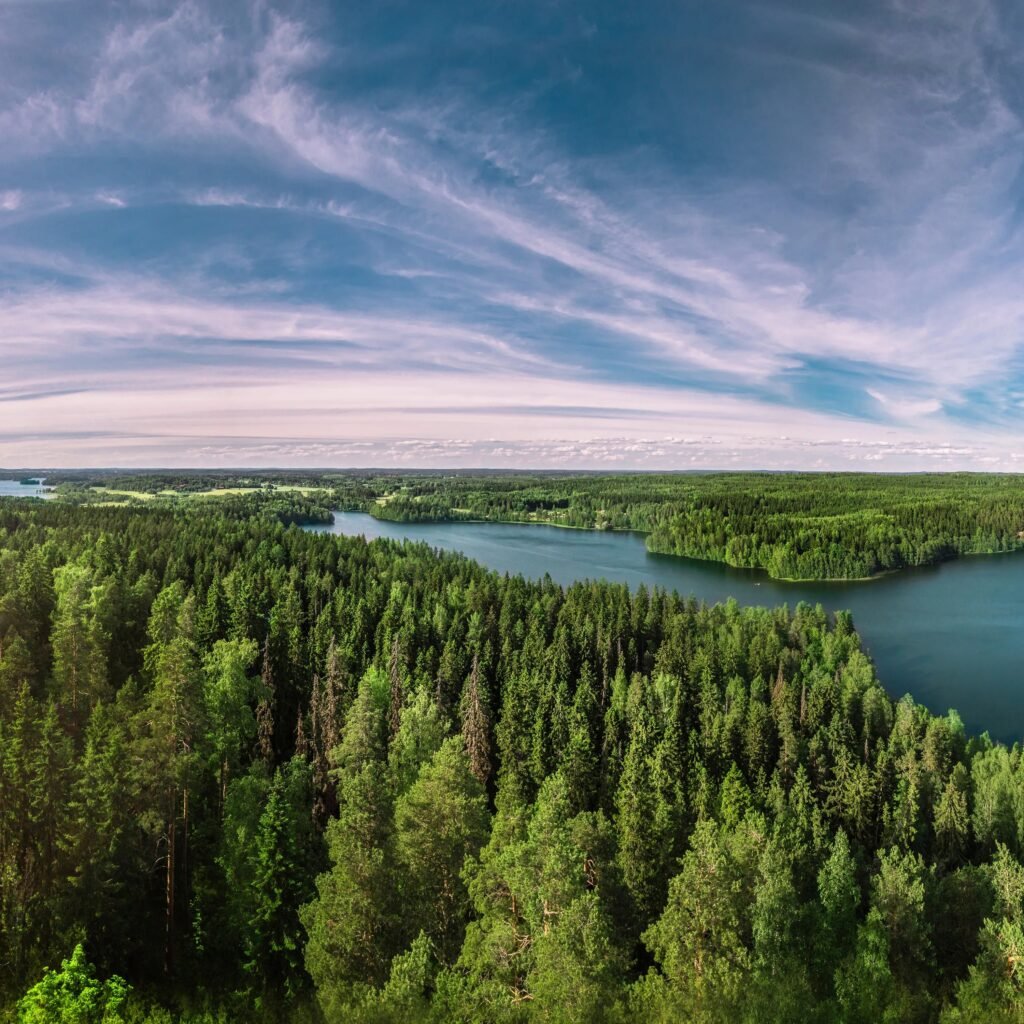
There is something almost paradoxical about Finland.
Geographically, it sits in the far north of Europe, close to the Arctic Circle. Much of the year is cold, dark and austere. Winter can bring long periods of limited daylight, while summer reverses the experience with extraordinarily long days. To someone accustomed to the warmth, colour and sunlight of India, Finland can appear almost like another world.
And yet Finland has occupied the top position in the World Happiness Report year after year. In the 2026 report, it remained number one for the ninth consecutive year, with an average life-evaluation score of 7.764 out of 10. India, by comparison, ranked 116th, with a score of 4.536.
So, what is happening in Finland?
Are Finns genuinely happier? Or are we misunderstanding what “happiness” means?
Perhaps the Finnish story is not about happiness in the conventional sense at all. It is about contentment, security and the ability to live without carrying an excessive burden of anxiety.
And that distinction has an important lesson for India.
The Finnish paradox
If happiness were simply a consequence of sunshine, warm weather, social celebrations, religious faith and visible enjoyment of life, Finland should not be at the top of the table.
India would appear to have many natural advantages.
We have sunlight throughout much of the year. We have an extraordinary diversity of landscapes, climates and cultures. We have festivals, family gatherings, food, music, religion, spirituality and an intensely social way of life.
Yet India is far below Finland in the international happiness ranking.
This tells us something important.
Happiness is not simply an emotion produced by pleasant surroundings.
The World Happiness Report itself makes this distinction. Its ranking is based on people’s assessment of the quality of their lives on a 0–10 scale, rather than on how frequently they smile, celebrate or experience pleasurable emotions. The Report’s statistical analysis finds that six broad factors—GDP per capita, healthy life expectancy, social support, freedom to make life choices, generosity and perceptions of corruption—together explain more than three-quarters of the variation in national life evaluations.
That gives us a much more interesting way of looking at Finland.
Perhaps Finland has not manufactured happiness. It has manufactured security.
This may be the central lesson.
Imagine two people.
One has a modest income but knows that if he becomes ill, there is healthcare; if he loses his job, there is social protection; if his child needs education, there is a functioning public system; if he reaches old age, there is a pension; and if he encounters a government institution, he generally expects the system to work.
Another may have a warm climate, a loving family and a rich cultural life, but constantly worries about employment, medical expenses, children’s education, housing, transport, retirement and dealing with institutions.
Who is more likely to rate his life as a whole highly?
The answer becomes less mysterious.
Finland’s happiness may therefore be partly the result of something much less glamorous than happiness: the removal of avoidable insecurity.
Money does matter—but only up to a point
There is sometimes a tendency to say that money cannot buy happiness.
That statement is too simplistic.
Money may not buy love, friendship or meaning. But the absence of money can create anxiety, deprivation and dependence.
The difference in economic circumstances between Finland and India is enormous. World Bank data put 2025 GDP per capita at about $56,149 in Finland and $2,703 in India at current US-dollar prices. On a purchasing-power basis, the figures are approximately $65,885 and $11,748 respectively.
These are not trivial differences.
For a person who cannot comfortably meet basic needs, additional income can transform life.
For a person whose basic needs are already secure, another increment of income may make much less difference.
Thus, happiness appears to have a hierarchy.
First comes survival.
Then security.
Then comfort.
Only after these are reasonably assured does the search for fulfilment, meaning and self-expression become dominant.
This is why economic development remains an important part of India’s happiness agenda.
But GDP alone cannot manufacture happiness
Here Finland offers another lesson.
If GDP were sufficient, every rich country would occupy the top of the happiness table.
That clearly isn’t the case.
The World Happiness Report finds that GDP is strongly associated with life evaluation, but social support, freedom, generosity, health and perceptions of corruption also matter. Social factors are particularly important in explaining positive and negative emotions.
This is where the Finnish model becomes more profound.
A society can be prosperous and still be unhappy if people do not trust one another, feel isolated, lack freedom or believe that institutions are unfair.
Finland has historically performed strongly on these dimensions.
But even Finland is not frozen in perfection. An OECD study published in 2026 found rising loneliness and social isolation across age groups since 2018 and warned that subjective wellbeing among younger Finns has become more fragile.
This is important.
Finland has not discovered a permanent formula for happiness.
It has built a society in which many of the conditions supporting contentment are relatively strong—but those conditions themselves require constant maintenance.
India’s apparent disadvantage may actually contain an advantage.
India’s position should therefore not be interpreted as:
Finland is happy; India is unhappy. India possesses enormous reserves of another kind of wealth.
Family remains an important source of emotional support. Community life remains strong in many places. Religion and spirituality provide meaning to millions. Festivals bring people together. Food, music, neighbourhood relationships and social interaction create experiences of joy that may not be captured by a single life-evaluation question.
A person may live a financially difficult life and nevertheless experience extraordinary happiness at a family gathering, during a festival, in a place of worship or while helping another person.
That is real happiness.
But there is a paradox.
A person can experience moments of intense happiness and still judge his overall life poorly. Why?
Because life satisfaction asks a larger question: “If you look at your life as a whole, how well is it going?”
This is where India’s material and institutional difficulties become important.
India’s problem may not be a shortage of happiness—but an excess of burdens
Consider the ordinary Indian citizen.
There may be family warmth, friendship, religion, food and celebration.
But there may also be:
- uncertainty of employment;
- inadequate household income;
- expensive private healthcare;
- intense educational competition;
- difficult commuting;
- inadequate public infrastructure;
- pollution;
- housing pressures;
- bureaucratic friction;
- corruption;
- weak social protection;
- anxiety about children’s future;
- deprived of education due to social structure;
- anxiety about retirement;
- a life full of chaos.
These burdens accumulate.
The result can be a society in which people experience plenty of happiness but insufficient contentment.
That may be the most useful distinction between India and Finland.
Happiness is an emotion. Contentment is an assessment of life.
India may have no shortage of the first.
It needs more of the second.
So, what can India learn from Finland?
The answer should not be to copy Finland.
India cannot—and should not—become Finland.
We have different histories, climates, populations, cultures, family structures and economic circumstances.
The lesson is to identify the conditions that produce contentment and build them within the Indian context.
1. Raise the material floor
Economic growth should ultimately be judged not merely by GDP but by whether ordinary households experience a meaningful improvement in their standard of living.
The question should be:
Can an ordinary family live with dignity without constantly worrying about the next financial shock?
Higher productivity, better wages, more formal employment and affordable housing are therefore happiness policies as much as economic policies.
2. Reduce the fear of illness
A single serious illness should not have the power to destroy a family’s financial stability.
Universal access to affordable, quality healthcare can remove one of the largest sources of household anxiety.
A healthier population also creates a double dividend: longer life and better life satisfaction.
3. Make public institutions predictable
This may be one of the most important lessons from Finland.
People can tolerate an unfavourable decision more easily when they believe that the rules are fair and predictable.
What destroys contentment is not merely a bad outcome.
It is the feeling that:
“I cannot predict what will happen unless I know the right person, pay somebody or struggle endlessly with the system.”
Reducing corruption, improving public services and making government more responsive can therefore have a psychological impact far beyond their administrative value.
4. Preserve India’s social capital
India’s family networks, neighbourhood relationships, festivals, religious institutions and community traditions are valuable sources of social support.
The World Happiness Report identifies having someone to count on as one of the strongest factors associated with life evaluation and emotional wellbeing.
India already possesses much of this social capital.
The challenge is to modernise without destroying it.
Economic development should not produce a society where everyone has a larger house, a bigger car and a better smartphone—but nobody has time for the neighbour, the parent, the friend or the community.
5. Create freedom from unnecessary competition
India’s aspiration for a better life has sometimes become an endless race.
Better marks.
Better college.
Better job.
Bigger salary.
Bigger house.
More status.
More possessions.
There is nothing wrong with ambition.
But a society should ask when ambition becomes permanent psychological competition. In the race for becoming number one, you can lose your inner peace, your innocence, your passion, your moral and much more.
Finland offers an alternative possibility: a society in which a reasonably ordinary life can itself be considered a successful life.
India could benefit from creating the same dignity around an ordinary, secure existence.
The Finnish citizen pays more—but does he worry less?
There is another dimension to the Finnish happiness paradox that cannot be ignored: taxation.
A Finnish citizen pays considerably more in taxes and social contributions than an average Indian citizen. At first sight, this might appear to work against happiness. But taxation tells only half the story. The other half is what the citizen receives in return.
In Finland, a significant part of the tax burden is converted into healthcare, education, pensions, unemployment protection, family benefits, public infrastructure and other social services. The citizen therefore does not have to bear every major risk individually.
This creates an interesting psychological equation:
Higher taxation → collective provision → lower individual risk → greater security.
The Finnish citizen may therefore pay more, but he may also worry less.
An Indian citizen, by contrast, may pay less direct income tax, particularly at lower income levels, but often has to make substantial private provision for healthcare, education, housing, transport, retirement and other necessities. The apparent saving in taxation can therefore be partly offset by a higher burden of private expenditure and personal risk.
The real comparison, therefore, should not be:
“How much tax does a Finnish citizen pay compared with an Indian?”
It should be:
“After paying taxes, how much does the citizen still have to spend privately to obtain security and essential services?”
This is where the Finnish social contract becomes important. Citizens accept a relatively high tax burden partly because they expect the state to deliver reliable services in return. The relationship is not simply taxpayer versus government; it is a form of collective insurance.
This does not mean that Finnish public services are perfect, nor that higher taxation automatically produces happiness. Finland itself faces pressures on healthcare, public finances and social wellbeing. But when citizens believe that the system is broadly fair, predictable and functional, taxation can actually reduce anxiety rather than increase it.
Perhaps this is one of the less visible ingredients of Finnish contentment:
The state does not merely collect a large share of the citizen’s income; it also absorbs a significant share of the citizen’s risks.
For India, the lesson is not that we should simply impose Finnish levels of taxation. India’s average income is far lower, and such a comparison would be inappropriate. The more relevant lesson is that economic growth should gradually be converted into economic security.
As India becomes richer, citizens should increasingly feel that taxes and public expenditure are buying something tangible: better healthcare, better education, reliable infrastructure, social protection, dignified old age and a government that works without excessive friction.
Ultimately, the question is not whether the citizen pays more or less.
It is whether, after paying the state, he feels that the state has taken some of his worries away.
Can happiness actually be manufactured?
Perhaps not.
Happiness cannot be manufactured like a consumer product.
But the conditions for happiness can be manufactured.
We can manufacture:
security.
health.
freedom.
trust.
good institutions.
opportunity.
clean public spaces.
better civic sense.
social protection.
economic dignity.
And we can protect:
family.
community.
culture.
spirituality.
nature.
human relationships.
The combination may be much more powerful than either material prosperity or cultural richness by themselves.
The Finnish lesson for India
Perhaps the greatest lesson from Finland is not that Finns have discovered how to be happy.
It is that a society can deliberately reduce the things that make ordinary people unhappy.
Finland’s cold does not disappear.
Its long winter nights do not disappear.
Its geographical location does not change.
And yet a person can look at his or her life and say:
“I am safe. I have enough. I can trust the system. I have people I can count on. I am free to live my life. Tomorrow is unlikely to destroy everything I have built today.”
That is an extraordinarily powerful form of happiness.
India already possesses something Finland cannot easily manufacture: sunlight, colour, family, community, spirituality, diversity, food, celebration and an enormous capacity for human warmth.
What India needs to build is the other half of the equation:
economic dignity + institutional trust + social security + personal freedom + good health.
Perhaps the ultimate objective should therefore not be to make India the “happiest country in the world.” It should be something more fundamental:
To make an ordinary Indian life less burdensome, more secure and more dignified—while preserving the warmth and humanity that already make that life worth living.
If we can accomplish that, happiness may not need to be manufactured at all.
It may emerge naturally.