
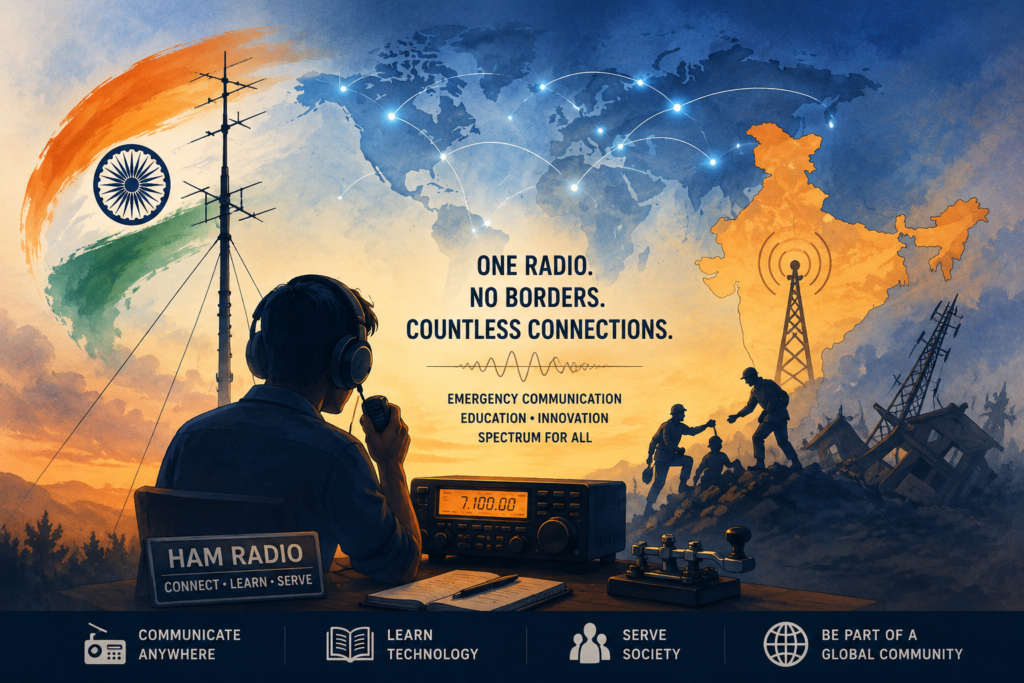
Imagine a day when every mobile tower around you stops working. The internet disappears. WhatsApp, mobile calls, GPS and social media all go silent. Yet one person in your neighbourhood continues talking effortlessly to people hundreds—or even thousands—of kilometres away using nothing more than a small radio, a battery and a simple wire antenna.
That person is a licensed amateur radio operator.
In an age dominated by smartphones and cloud-based communication, HAM radio remains one of the last technologies that allows ordinary citizens to communicate independently of commercial infrastructure. Unfortunately, India has almost forgotten this remarkable technology.
More than a Hobby
- The one powerful reason for anyone to take the leap and get the HAM license is the thrill of real-world, infrastructure-independent connectivity. In an era where every message we send is mediated, tracked, and stored by tech corporations, telecom networks, and cloud servers, HAM radio is one of the last frontiers of true communication freedom.
- The moment a severe cyclone, flood, or earthquake hits, mobile towers drop within hours due to power failure or network congestion. A licensed HAM operator becomes the only person in the neighbourhood who can reliably communicate with the outside world using nothing but a radio and a car battery. It transforms the hobby from a pastime into a superpower.
- The fact that HAM can bounce a signal off the ionosphere and speak to someone in Japan or Europe—using an antenna they built themselves out of ordinary copper wire—is inherently fascinating. It taps into the human urge to explore and experiment.
- A country with a high density of HAM operators naturally builds a pipeline of self-taught engineers and innovators. HAM radio forces you to look inside the box. To get on the air, you learn applied physics, electromagnetic wave propagation, circuitry, and audio technology. If a HAM needs a better signal, they build a directional antenna. This hands-on problem-solving is exactly what drives industrial innovation.
- HAM radio is one of the very few spaces left on earth completely untouched by political borders, algorithms, or commercial advertising. HAM etiquette strictly forbids discussions of politics, religion, or business on the air. It creates a uniquely clean, courteous global community focused entirely on human connection and technical curiosity.
- People don’t realize that the radio spectrum is highly regulated, valuable real estate. HAMs act as active custodians of the radio spectrum. By utilizing their allocated frequencies, they keep vital bands of the electromagnetic spectrum active, public, and free from total corporate commercialization. Getting a license is literally getting a government passport to transmit signals on frequencies that are otherwise completely illegal to touch.
Every HAM operator represents a trained citizen capable of contributing during disasters, inspiring technological innovation and strengthening the nation’s communication resilience.
India’s disappointing numbers
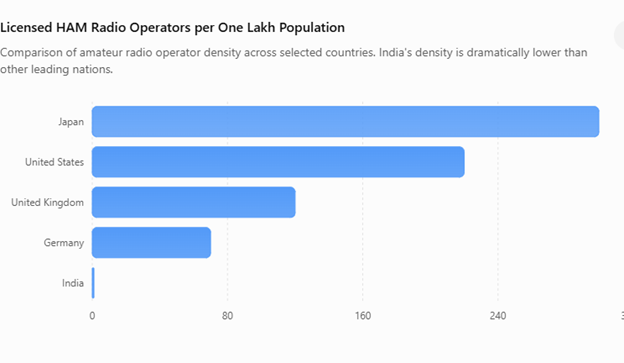
India is the world’s most populous nation, yet has only about 22,000 licensed amateur radio operators—roughly one operator for every one lakh people. Countries such as Japan and the United States have more than two hundred times this density.
In countries like the US and Japan, amateur radio is a massive, deeply rooted subculture supported by major electronics manufacturers. In India, it remains a highly niche community.
Why India fell behind
India’s poor HAM radio culture was not caused by a single problem. It emerged from decades of policy, economic and technological factors working together. Several historical, financial, and bureaucratic hurdles have kept the hobby from expanding in large numbers:
- Bureaucratic intervention: Historically, the process starting from conducting the exam and the amateur license is managed by the Wireless Planning & Coordination (WPC) wing. Earlier, this process used to take 2 years. The mandatory police and intelligence background checks often caused massive delays because amateur radio wasn’t a priority for local law enforcement. Also, a narrative was spread among the Police that the HAMs will carry similar walkie-talkies and would intercept their messages.
- High Equipment Costs: For a long time, standard HF/VHF transceivers were heavily taxed and imported, making a decent station setup cost upwards of ₹40,000+. For a hobby, this price barrier was far too high for the average Indian middle-class household.
- Lack of Local Ecosystem: Developed countries had thriving DIY radio kits and massive commercial manufacturers that made entry easy. India lacked a widespread domestic commercial manufacturing ecosystem for consumer amateur radio gear.
- The “Smartphone” Eclipse: By the time disposable incomes rose in India, cheap smartphones and ultra-low-cost internet arrived. The younger generation jumped straight to digital platforms, bypassing the “tinkering” phase with analog radio waves.
- Low Awareness: To the general public, radio is something you listen to (FM/AM). Very few people realize they can legally build a station and talk across the globe for free.
How India can create a HAM revolution
- Simplify and Modernize the Onboarding Process
- The simplification of the amateur radio examination and licensing process in recent years have got an impetus with the publication of Telecommunications (Amateur Services) Rules, 2024 (182ac6995765c1828cb42debe7a22b3e.pdf) . While the WPC has also digitized parts of the application process recently. One immediate step that should be taken is to strengthen online testing process where test results and provisional call signs are generated within days, instead of months.
- Introduce Radio Tinkering in Schools and Colleges
- Amateur radio needs to be positioned as a gateway to Science, Technology and Engineering. Integrating simple antenna building or basic electronics projects into the Atal Tinkering Labsacross Indian schools would spark early interest. Engineering colleges and polytechnics should be incentivized to maintain active HAM clubs and repeaters.
- Encourage “Maker” Culture and Open Source
- With the global rise of open-source hardware (like Raspberry Pi) and cheap Software Defined Radios (SDRs), the hobby is no longer strictly about massive, expensive desktop rigs. Promoting low-cost, home-brewed digital data modes can appeal directly to tech-savvy youth who like coding and automation.
- Leverage HAM for Disaster Management Integration
- HAM radio operators are most visible during natural disasters (like the Chennai floods or cyclones) when cell towers fail. Organizations like the National Disaster Management Authority (NDMA) could actively sponsor or subsidize HAM training for community volunteers, civil defense personnel, and scouts to build a massive, decentralized emergency communication backup grid.
When the Internet Goes Silent
Modern communication has made us more connected than ever before—but also more dependent than ever before. Every message today passes through commercial networks, cloud servers and digital platforms. HAM radio is different. It is direct, personal and remarkably resilient.
A HAM licence is far more than permission to own a radio. It is a licence to explore science, experiment with technology, serve society during emergencies and become part of a worldwide community united by curiosity rather than commerce.
India dreams of becoming a global technology leader by 2047. That ambition cannot rest solely on semiconductor fabs, satellites and artificial intelligence. It must also encourage ordinary citizens to experiment, build, communicate and innovate.
Increasing the number of amateur radio operators is therefore not merely about expanding a hobby. It is about creating a nation that is technically curious, resilient during disasters and better prepared for the future.
When the internet goes silent, the world falls quiet for most people. For a HAM operator, the conversation has only just begun.
| What Does It Take to Become a HAM? | |
| Step | What You Need to Know |
| 📖 Learn the Basics | Understand radio communication, operating procedures, elementary electronics, and the regulations governing amateur radio. Numerous clubs and online resources provide free guidance. |
| 📝 Pass the Examination | Clear the Amateur Station Operator’s Certificate (ASOC) examination conducted under the Ministry of Communications. The examination primarily tests radio theory, operating practices, and relevant regulations. |
| 📜 Obtain Your Licence | After qualifying and completing the licensing formalities, you are issued an Amateur Radio Licence along with your unique call sign—your personal identity on the airwaves. |
| 📡 Set Up a Station | Beginners can start with a handheld VHF/UHF radio costing around ₹3,000–₹10,000. More advanced HF stations capable of worldwide communication typically cost ₹40,000–₹1.5 lakh, although many enthusiasts begin with second-hand equipment or build their own antennas. |
| 🌍 Start Communicating | Join local HAM clubs, participate in emergency communication exercises, experiment with antennas and digital modes, and connect with operators across India and around the world. |