
Strategic Choices for 5G, 5G-Advanced and 6G
Introduction
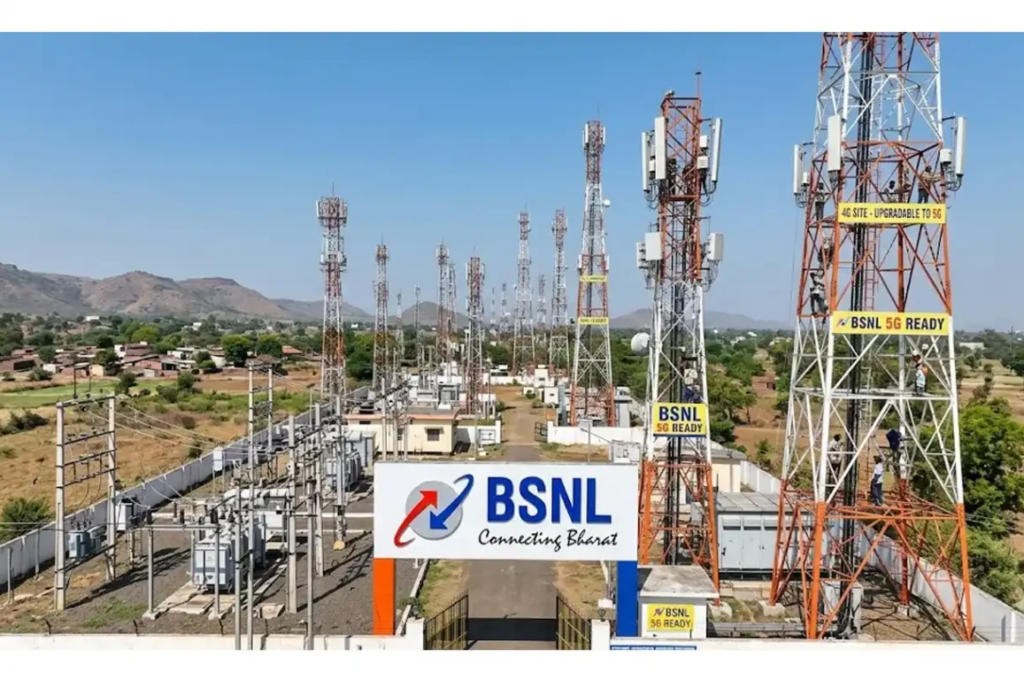
India’s indigenous 4G programme has reached a significant stage. What began as an effort to create a domestic alternative to foreign telecom equipment has now evolved into a functioning ecosystem involving C-DOT, TCS, Tejas Networks and other Indian partners. BSNL is deploying one lakh indigenous 4G sites across India, and the equipment has been designed with a pathway towards 5G. As of March 2026, the Government reported that BSNL was rolling out these one lakh indigenous 4G sites as part of its revival and transformation programme.
C-DOT’s 2024–25 Annual Report indicates that its 4G/5G NSA core has already been deployed in BSNL’s pan-India 4G network, with more than 75,000 RAN sites integrated with the C-DOT core at that stage. C-DOT is simultaneously developing a disaggregated 5G Bharat RAN with consortium partners.
The strategic question, therefore, is no longer whether India should have indigenous telecom technology. That question has effectively been answered.
The more difficult question is:
How should BSNL convert the indigenous 4G ecosystem into a platform for advanced 5G, 5G-Advanced and ultimately 6G without allowing the technology to become obsolete before it reaches commercial maturity?
The approach of BSNL be that it should neither abandon indigenous development in favour of foreign technology nor attempt to develop every successive generation in isolation.
The preferred approach is:
Indigenous core and RAN capability + open interfaces + global interoperability + selective global technology partnerships coupled with commercially disciplined 5G deployment → continuous migration towards 5G-Advanced and 6G.
The objective should be to transform BSNL from merely a recipient of indigenous technology into India’s large-scale technology validation and commercialisation platform.
1. The Strategic Context – To create an evolutionary technology platform
The telecom industry is moving through generations at an accelerating pace.
India’s private operators began commercial 5G services in 2022. By February 2026, 5G had reached 99.9% of India’s districts, with approximately 5.23 lakh 5G BTSs deployed nationally. The private operators therefore have several years of operational experience and enormous network scale over BSNL.
At the same time, India is already preparing for 6G. The Bharat 6G Vision seeks to make India a frontline contributor to the design, development and deployment of 6G by 2030. By February 2026, 136 projects had been approved under the Telecom Technology Development Fund, of which 104 were related to 6G, covering areas such as THz communications, cell-free networks, RIS, AI/ML and other advanced technologies.
Thus BSNL faces a peculiar situation:
4G is still being rolled out → 5G is already mature globally → 5G-Advanced is emerging → 6G R&D is accelerating.
The challenge for BSNL is therefore not simply to complete 4G and then move to 5G.
It is to create an evolutionary technology platform in which investment in today’s network remains useful for tomorrow’s technology including 5G and 6G.
2. The Indigenous 4G Ecosystem: India’s Strategic Asset
The indigenous 4G programme should not be evaluated merely in terms of whether it is cheaper or more expensive than imported equipment.
Its strategic value lies in the ecosystem that it has created.
The broad architecture involves:
C-DOT: Core technology and telecom R&D
TCS: System integration and large-scale deployment
Tejas Networks and other Indian partners: RAN and equipment
BSNL: National-scale deployment and operational environment
This represents something that India historically lacked: a domestic telecom technology development-to-deployment chain.
C-DOT’s current documentation shows that its 4G/5G core is already deployed in BSNL’s network, while indigenous RAN development is continuing.
The significance is therefore much greater than the 4G network itself.
It creates:
- indigenous intellectual property;
- engineering expertise;
- software capability;
- systems integration capability;
- telecom manufacturing capability;
- network-operation experience;
- standards participation;
- an Indian vendor ecosystem;
- and, critically for the fruition of R&D BSNL offers a domestic customer willing to deploy the technology.
That last component is particularly important.
Without BSNL platform for experimentation, Indian telecom R&D could remain trapped in laboratories and demonstrations.
3. The Case for Continuing Indigenous Development
3.1 Strategic autonomy
Telecom networks constitute critical national infrastructure.
Dependence on a small number of foreign technology suppliers creates risks involving:
- supply chains;
- cybersecurity;
- geopolitical restrictions;
- software dependence;
- technology licensing;
- upgrades;
- and vendor lock-in.
Indigenous capability provides strategic alternatives.
C-DOT itself has explicitly identified the need for indigenous technology to reduce dependence on global suppliers and to create solutions that can eventually compete internationally.
The argument is therefore not simply economic nationalism.
It is a question of technological sovereignty.
3.2 Indigenous capability creates negotiating power
Even if BSNL ultimately purchases some technology from global suppliers, possessing a credible domestic alternative changes India’s bargaining position.
A country that can say: “We can develop this ourselves if necessary” has considerably greater negotiating strength than one that has no alternative.
Therefore, indigenous R&D has value even when the resulting product does not capture the entire domestic market.
3.3 5G and 6G are evolutionary
One of the strongest arguments for continuing with the indigenous 4G platform is that telecom generations are not completely independent technologies.
The transition involves evolution of:
- software;
- cloud-native architecture;
- distributed computing;
- RAN;
- antennas;
- massive MIMO;
- network orchestration;
- AI/ML;
- edge computing;
- network slicing;
- security;
- and network management.
C-DOT’s 5G SA solution already incorporates several of these capabilities, including service-based architecture, control/user-plane separation, Edge Computing and network slicing. It is also designed to integrate with gNodeBs from multiple vendors.
Consequently, the knowledge accumulated through 4G and 5G can become part of India’s 6G competence.
4. The Case Against an Exclusively Indigenous Approach
The case for indigenous development should not become an argument for technological isolation.
There are serious risks.
4.1 The technology cycle is faster than the institutional cycle
A major problem with government-supported technology development is that development timelines can be longer than commercial technology cycles.
An indigenous product may follow this path:
R&D → prototype → testing → field trial → certification → procurement → deployment
while the international market is simultaneously moving:
4G → 5G → 5G-Advanced → 6G research.
If the institutional process takes too long, a technically successful product may reach the market when the global technology has already moved to the next stage.
This is perhaps the greatest strategic risk facing the indigenous model.
4.2 BSNL cannot become the permanent absorber of technology risk
BSNL has received substantial government support. Three revival packages have amounted to approximately ₹3.22 lakh crore, including capital infusion, debt restructuring, viability-gap funding and spectrum support.
Government support is justified where BSNL performs strategic and public-service functions.
However, there is a limit to how much commercial technology risk BSNL should carry.
There is a danger that:
BSNL becomes the market for (dumping) technologies because the technologies need a market, rather than choice of technologies for an operator because BSNL has a compelling commercial requirement for them.
That would weaken commercial discipline.
5. The Central Dilemma: Indigenous Development versus Global Technology
The issue can be expressed simply.
The argument for indigenous development
“If India stops developing technology, it will permanently remain a technology consumer.“
But the counterargument is:
“If India insists on developing everything independently, it may arrive technologically late.”
The correct answer therefore lies between the two extremes.
The objective should be: Indigenous technological capability without technological isolation.
6. Why the RAN Requires Special Attention
The distinction between the core and RAN is particularly important.
It would be relatively easy to construct a strategy in which:
C-DOT → indigenous 5G SA core along with Nokia/Ericsson/Samsung → RAN
Such a model might allow BSNL to launch services faster. But it carries a strategic risk.
The RAN is central to future wireless technology.
Areas such as:
- massive MIMO;
- beamforming;
- advanced antennas;
- radio algorithms;
- AI-RAN;
- Open RAN;
- distributed RAN;
- cell-free networks;
- integrated sensing and communications;
- THz communications;
are closely related to the evolution towards 6G.
If India imports the RAN while developing only the core, it may gradually develop expertise in network integration and operation without developing sufficient expertise in advanced radio technology.
That would be a serious weakness for the 6G ambition.
C-DOT’s own 5G programme recognizes this. Its Bharat 5G solution includes an Open RAN architecture, while its broader 5G programme has historically envisaged separate consortia for SA core, Open RAN, transport, enterprise networks, security, analytics and network management.
Therefore: A foreign RAN should not become a permanent substitute for indigenous RAN R&D.
7. But Indigenous RAN Should Not Mean Indigenous Isolation
This is where Open RAN and multi-vendor interoperability become strategically important.
C-DOT’s 5G SA platform already supports integration with gNodeBs from multiple vendors, and its 5G RAN specifications include O-RAN compliance.
This creates a potentially powerful model:
Indian RAN ↔ Open interfaces ↔ Global RAN
rather than:
Indian RAN OR Global RAN
This means BSNL can use global technology where necessary while retaining indigenous R&D capability.
8. The Proposed “Learning Network” Model
BSNL should consider converting selected parts of its network into technology validation zones.
For example:
Track A – Commercial network
Use the most mature and commercially reliable technology available.
Track B – Indigenous technology network
Deploy C-DOT/Indian RAN in selected geographical areas, enterprises, government campuses and FWA applications.
Track C – Joint technology zones
Indian and global vendors collaborate on:
- interoperability;
- AI-RAN;
- Open RAN;
- massive MIMO;
- advanced antennas;
- network automation;
- energy efficiency;
- 5G-Advanced.
The result would be a continuous technology feedback loop:
Research → Prototype → BSNL field deployment→ Real-world performance data →
Technology improvement →Commercial product→5G-Advanced / 6G
This could become one of BSNL’s most valuable strategic roles.
9. 5G Should Be Selective Rather Than a Race for Mass-Market Leadership
BSNL should not attempt to reproduce Jio or Airtel’s 5G strategy.
The private operators already possess:
- massive 5G scale;
- large customer bases;
- extensive device ecosystems;
- established consumer brands;
- several years of operational experience.
BSNL would have to spend enormous amounts of capital merely to catch up.
Instead, BSNL should concentrate on applications where its institutional strengths matter.
Priority areas
- 5G Fixed Wireless Access
- Enterprise connectivity
- Government networks
- Private 5G
- Rural broadband
- Industrial connectivity
- Smart manufacturing
- Railways and transport
- Defence and strategic communications where appropriate
- Education and healthcare
- Agriculture and rural applications
- Edge computing
The indigenous 5G FWA experience is particularly relevant. BSNL announced an indigenous 5G FWA soft launch in Hyderabad in 2025, using an indigenous core, RAN and CPE and positioning the solution for broadband and enterprise applications.
This is a better commercial laboratory than attempting immediately to compete for millions of mainstream smartphone 5G customers.
10. The Economic Principle for BSNL’s Technology Investment
Every technology investment by BSNL should satisfy at least one of two tests:
Test 1 – Commercial return
Will this investment generate:
- additional revenue;
- subscribers;
- enterprise customers;
- lower operating costs;
- better spectrum utilisation;
- or improved network efficiency?
Test 2 – Strategic technology return
If it does not generate an immediate commercial return, will it create a clearly identifiable capability required for:
- 5G-Advanced;
- 6G;
- telecom security;
- advanced RAN;
- AI-native networks;
- satellite/NTN;
- or other strategic technologies?
If an investment satisfies neither test, BSNL should not undertake it merely because the technology is indigenous.
This principle would reconcile Atmanirbhar Bharat with commercial discipline.
11. The 4G Ecosystem Should Become a Platform, Not a Destination
The one lakh indigenous 4G sites should therefore be viewed as the first layer of an evolutionary platform.
The pathway could be:
Phase I: Indigenous 4G
Phase II:5G NSA/SA capability
Phase III: 5G Advanced
Phase IV: AI-native/Open RAN
Phase V: 6G
The important point is that each phase should reuse as much of the previous investment as technologically and economically sensible.
12. Proposed Architecture for the Way Forward
| Layer | Recommended approach |
| 4G Core | Continue indigenous C-DOT platform |
| 4G RAN | Complete indigenous rollout and optimise |
| 5G SA Core | Indigenous C-DOT core should remain a strategic asset |
| 5G RAN | Indigenous RAN should be commercially validated |
| Global RAN | Use selectively for benchmarking, capacity and interoperability |
| Open RAN | Make it a major strategic direction |
| Software to tune O-RAN | Strong Indian R&D priority |
| AI/ML network management | Indian research + global collaboration |
| 5G-Advanced | Joint Indian industry/academic programme |
| 6G | Indian-led R&D with global standards participation |
| FWA | Major early commercial 5G opportunity |
| Enterprise/private 5G | High-priority SA application |
| Rural 5G | Targeted deployment based on social/economic need |
| Consumer 5G | Selective rather than nationwide catch-up strategy |
13. Global Partnerships: What They Should and Should Not Mean
A global partnership should not mean: “India develops the core and imports everything else.” Nor should it mean: “India refuses to use foreign technology.”
The preferred model is:
Global partners provide
- technology benchmarking;
- interoperability;
- global deployment experience;
- standards expertise;
- performance validation;
- joint R&D;
- technology transfer where feasible;
- access to global markets.
Indian ecosystem provides
- core technology;
- RAN development;
- software;
- Open RAN;
- AI/ML;
- applications;
- system integration;
- local manufacturing;
- indigenous IP.
The partnership should therefore be capability-enhancing rather than capability-substituting.
14. Indigenous Development: Arguments For and Against
| Issue | Case for Indigenous Development | Case Against / Risk |
| National security | Reduces dependence on foreign suppliers | Domestic alternatives may initially have smaller ecosystem support |
| Technology sovereignty | Builds strategic capability | Can encourage technological isolation |
| 6G preparation | Builds R&D skills and IP | Slow development may miss global technology windows |
| RAN capability | Creates advanced wireless expertise | RAN is technically difficult and capital intensive |
| Economic value | Creates Indian industry and jobs | Government-funded demand may not prove market competitiveness |
| Intellectual property | Creates Indian SEPs and patents | IPR alone does not guarantee commercial success |
| Rural requirements | Technology can be customised for Indian needs | Rural ARPU may not justify commercial investment |
| Cybersecurity | Greater control over software and architecture | Indigenous software also requires extensive security validation |
| Vendor independence | Reduces vendor lock-in | Multi-vendor ecosystems create integration complexity |
| Global competitiveness | Potential to develop exportable products | Domestic products must achieve global quality and cost standards |
| 6G | Creates technological continuity | Resources devoted to 4G/5G can crowd out frontier 6G research |
| BSNL | Gives BSNL strategic relevance | BSNL may become the absorber of technology-development risk |
| Innovation | Encourages domestic innovation | Protected markets can reduce competitive pressure |
| Standards | Enables India to contribute to global standards | Late participation can reduce influence |
| Long-term value | Builds national technological capability | Benefits may take many years to materialise |
15. What Should BSNL Avoid?
1) Avoid a nationwide 5G catch-up race: BSNL is unlikely to economically defeat Jio and Airtel by copying their strategy.
2) Avoid permanent dependence on foreign RAN: This could undermine India’s longer-term 6G radio capability.
3) Avoid technological isolation: Indigenous development should be benchmarked continuously against global leaders.
4) Avoid technology for technology’s sake: Every deployment should have a business case or a clearly defined strategic technology objective.
5) Avoid excessive fragmentation: Too many experimental vendors can create an unmanageable network.
6) Avoid treating 6G as a completely new project: Much of the capability should evolve from the 4G/5G ecosystem.
16. What BSNL Should Build
The target should be a multi-layer indigenous technology ecosystem.
Layer 1 – National 4G foundation: Complete and optimise the indigenous 4G network.
Layer 2 – 5G SA: Use the indigenous C-DOT core as the strategic foundation.
Layer 3 – Indigenous RAN: Continue development and deploy at meaningful commercial scale.
Layer 4 – Open RAN: Create interoperability with multiple Indian and global vendors.
Layer 5 – 5G-Advanced: Move quickly into,
- AI-RAN;
- advanced MIMO;
- network automation;
- energy efficiency;
- sensing;
- edge computing.
Layer 6 – 6G: Use the accumulated capability for,
- THz;
- cell-free networks;
- AI-native networks;
- NTN;
- sensing and communication convergence;
- advanced spectrum utilisation;
- new radio technologies.
India’s current 6G R&D programme already includes several of these areas, demonstrating that the transition is in pipeline.
17. The Role of C-DOT Must Also Change
C-DOT should gradually evolve from being primarily a government R&D institution into an orchestrator of the national telecom technology ecosystem.
Its role should include:
1)Research, Technology architecture, Standards, IP creation
2) Industry consortia, Productisation, Field validation
3) Global benchmarking, Technology transfer, 6G transition
C-DoT experiment shows that R&D alone does not create technological leadership. The missing link is commercialisation.
18. BSNL’s Unique Role in India’s Technology Strategy
- BSNL possesses something that C-DOT does not: a nationwide operational network and millions of customers.
- C-DOT possesses something that BSNL does not: a dedicated telecom technology R&D capability.
- Indian industry possesses: manufacturing, integration and commercialisation capability.
- Academia possesses: frontier research capability.
- Global technology companies possess: large-scale deployment experience and global benchmarking.
The strategic opportunity is therefore to combine these assets.
The ecosystem should look something like:
Academia
↓
C-DOT
↓
Indian start-ups / industry
↓
BSNL field deployment
↕
Global technology partners
↓
International standards
↓
Commercial products
↓
5G-Advanced / 6G
19. The Proposed Strategic Doctrine
The future BSNL technology policy could therefore be built around five principles.
Principle 1
Indigenous capability is non-negotiable in strategic technologies.
Principle 2
Indigenous does not mean isolated.
Principle 3
BSNL should deploy technology where it has a commercial or strategic purpose.
Principle 4
Foreign technology should supplement Indian capability, not permanently replace it.
Principle 5
Every generation should create capability for the next generation.
The fifth principle is particularly important. A 4G investment should contribute to 5G. A 5G investment should contribute to 5G-Advanced. 5G-Advanced should contribute to 6G.
If this chain breaks, every technology generation becomes a separate investment project.
20. A Possible Roadmap
| Period | Primary Objective | BSNL/C-DOT Role |
| 2026–27 | Complete indigenous 4G | Stabilisation, optimisation, service quality |
| 2026–28 | Targeted 5G SA | FWA, enterprise, government and selected urban deployments |
| 2027–29 | Indigenous Open RAN | Commercial validation and multi-vendor interoperability |
| 2027–30 | 5G-Advanced | AI-RAN, automation, advanced MIMO, edge and sensing |
| 2026–30 | 6G R&D | C-DOT + academia + industry + global alliances |
| 2028–30 | Standards/IP | Greater Indian participation in 3GPP and global standards |
| 2030 onward | 6G commercialisation | Indian technology combined with global interoperability |
* These dates should only be regarded as strategic milestones.
21. The Most Important Shift: From “Indigenous Procurement” to “Indigenous Capability”
The ultimate measure of success should not be: “How much indigenous equipment did BSNL purchase?”. It should be: “How much technological capability has India acquired through the BSNL deployment?”
This is a fundamental distinction. A network can have a high percentage of indigenous equipment and still produce little innovation. Conversely, a network can temporarily use some foreign components while creating a strong domestic R&D capability.
Therefore the metrics should include:
- Indian patents;
- Indian SEPs;
- indigenous software;
- RAN algorithms;
- network architecture;
- contributions to the Standards;
- Indian component ecosystem;
- export revenue;
- technology licensing;
- number of globally competitive vendors;
- commercial deployments outside India;
- R&D-to-revenue conversion;
- time from laboratory prototype to commercial product.
22. Conclusion
India should not choose between indigenous technology and global technology as though they were mutually exclusive alternatives.
The strategic choice is between: Indigenous capability with global integration and dependence on imported technology. The former should be India’s objective. But indigenous capability must be subjected to the same discipline as global technology such as performance, cost, reliability, scalability and time-to-market.
BSNL’s indigenous 4G programme provides India with an unprecedented opportunity because the basic ecosystem is now moving from laboratory development towards large-scale deployment. The government’s current policy support, C-DOT’s 4G/5G core deployment, indigenous RAN development and the emerging 6G ecosystem provide a foundation on which the next generation can be built.
The danger, however, is equally clear.
If BSNL spends the next several years merely completing 4G and then begins a conventional 5G programme, the global technology cycle may once again leave India behind. BSNL should not attempt to become the country’s largest 5G consumer operator. Its indigenous 4G network should therefore be treated not as the end-product of a government programme but as the foundation of a continuous technology evolution platform.
The strategic architecture, if the ecosystem can perform in the next four years to its fullest potential, can be summarized as:
Indigenous 4G → Indigenous 5G Core + Indigenous/Open RAN →Global interoperability and benchmarking → 5G SA applications and enterprise/FWA deployment → 5G-Advanced / AI-RAN → 6G R&D + standards + Indian IP → Globally competitive Indian telecom technology
The fundamental policy principle should therefore be:
- Technological sovereignty: Do not use indigenous technology merely to replace imports. Use deployment to create the capability to lead the next technology generation.
- Global benchmarking: Do not protect indigenous technology from global competition; expose it to global competition early enough to make it competitive.
The combination of these two principles offers BSNL and India a much more credible pathway from today’s indigenous 4G ecosystem to tomorrow’s 6G leadership.
© 2026 christopher.co.in