
Every Number Doesn’t Tell the Same Story
Every day, millions of Indians begin and end their journeys on foot. Walking is the oldest, simplest and most inclusive mode of transport, yet it remains the most vulnerable. Discussions on road safety therefore often focus on a single question: How many pedestrians died?
Kerala, however, presents a fascinating paradox.
Among the southern states, Kerala records the lowest absolute number of pedestrian fatalities. Yet pedestrians account for the highest proportion of all road accident deaths in the State. At the same time, Kerala also records India’s lowest Accident Severity Index, meaning that accident victims are significantly more likely to survive than elsewhere.
How can these three observations all be true?
The answer may lie in looking beyond conventional road safety statistics.
Three Numbers. Three Stories.
The first comparison is straightforward.
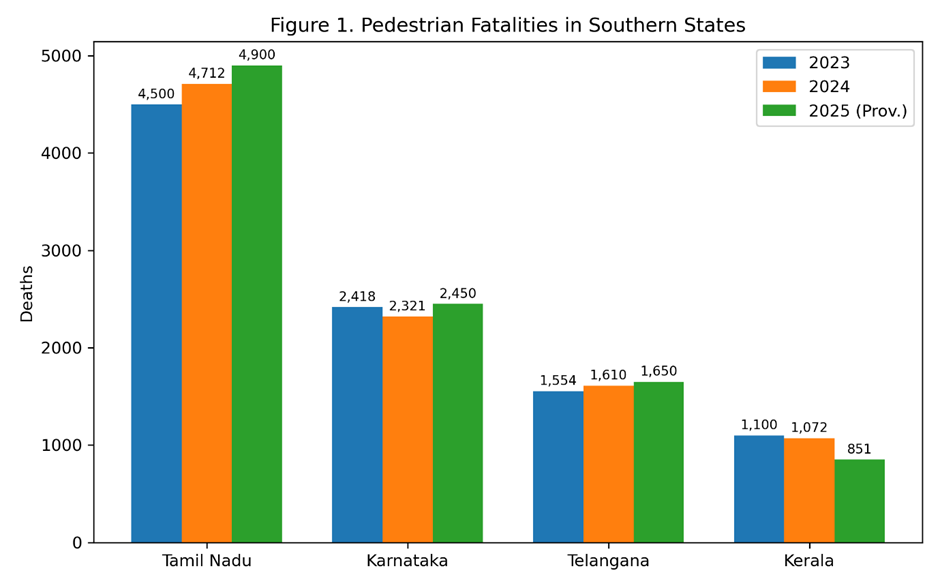
Figure 1 shows that Kerala consistently records fewer pedestrian deaths than Tamil Nadu, Karnataka and Telangana.
If absolute fatalities alone were used to judge road safety, Kerala would appear to be the safest of the four states.
But the story changes when another question is asked.
Instead of counting how many pedestrians died, suppose we ask:
What proportion of all road accident victims were pedestrians?
Figure 2 shows that nearly one in four road accident deaths in Kerala involves a pedestrian—the highest proportion among the southern states.
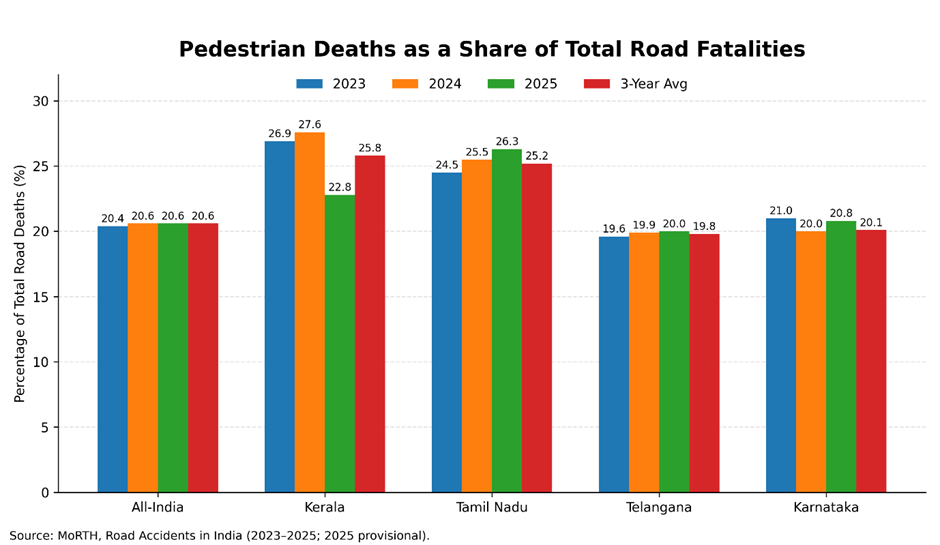
Now Kerala suddenly appears to be the most dangerous state for pedestrians.
A third indicator changes the picture once again.
The Accident Severity Index, shown in Figure 3, measures the number of persons killed for every hundred reported road accidents.
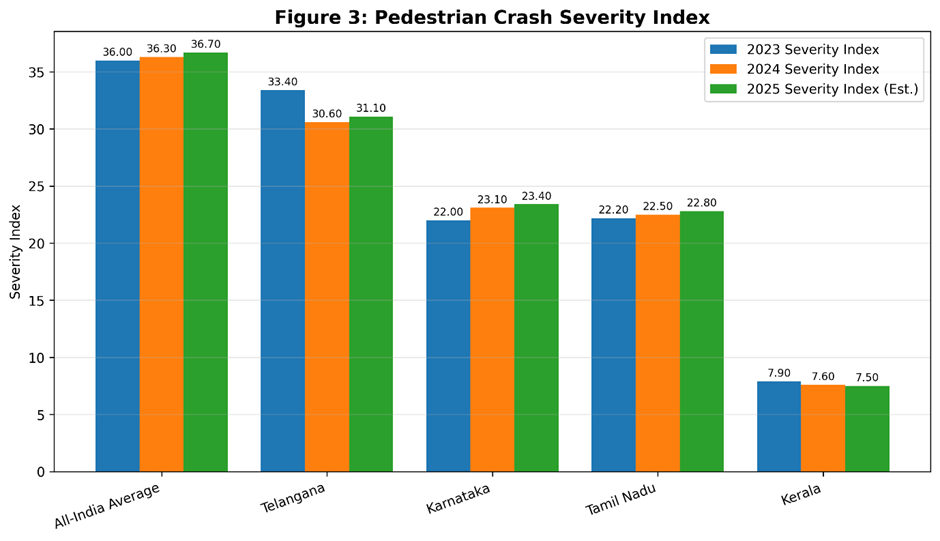
Here, Kerala performs better than every other state, recording roughly one death for every thirteen reported accidents, compared with far higher fatality rates elsewhere.
Three statistics.
Three different stories.
Rather than contradicting one another, they may be measuring different dimensions of road safety.
Looking Beyond Fatality Counts
Road safety is usually viewed through a single lens—the number of people killed.
But pedestrians experience risk in a more complex way.
This article proposes that pedestrian safety should be viewed through three interconnected dimensions:
- Pedestrian Exposure – How many people are exposed to moving traffic during their daily lives?
- Accident Survivability – How likely is an injured person to survive after a collision?
- Accident Severity – How deadly are road accidents once they occur?
Together these form what I call the Pedestrian Safety Triangle.
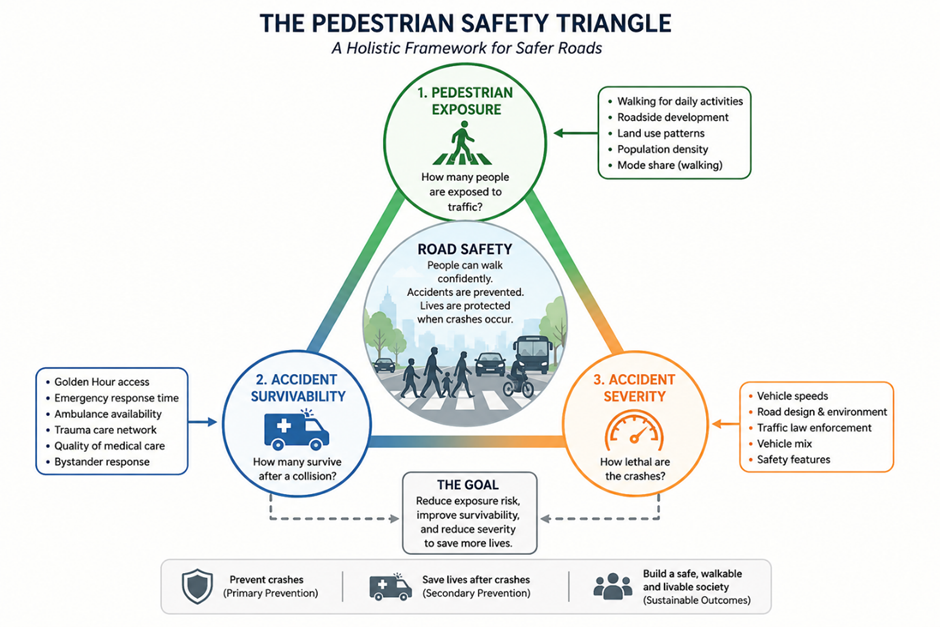
This framework suggests that high pedestrian fatalities cannot be understood without considering how many people are walking, how severe crashes become, and how effectively victims are treated after a collision.
Why Kerala May Be Different
Kerala’s pattern of development is unlike that of most Indian states.
Its towns, villages and commercial centres merge almost continuously along the road network. Schools, hospitals, markets and bus stops are usually within walking distance of residential areas. Naturally, this places far more pedestrians in contact with traffic throughout the day.
Greater pedestrian exposure may therefore explain why pedestrians constitute a relatively large share of accident victims.
At the same time, Kerala possesses characteristics that may improve survival after serious crashes. A dense network of hospitals, comparatively short travel distances, rapid emergency response and widespread AI-enabled speed enforcement may together create what can be described as a survival ecosystem.
The result may be fewer fatal outcomes even when accidents occur.
This hypothesis deserves further scientific investigation.
A Different Way to Think About Road Safety
The Kerala experience suggests that road safety cannot be measured solely by counting fatalities.
A transport system should certainly strive to prevent accidents. Equally important, however, is its ability to ensure that when accidents do occur, victims receive the greatest possible chance of survival.
Perhaps this is the real lesson emerging from Kerala’s experience.
Road safety is not simply about reducing accidents.
It is about creating roads where people can walk confidently, where collisions are less severe, and where lives are more likely to be saved.
As India continues to urbanise, future road safety policies may need to look beyond fatality counts and consider all three dimensions of the Pedestrian Safety Triangle—Exposure, Survivability and Severity.
After all,
Road safety should not be measured only by how many accidents we prevent, but also by how many lives we save.